Thursday, January 31, 2008

Seven Things

I've been tagged! Bebe over at Peaches and Dreams has asked me to reveal seven things about myself.

1. My favourite flowers are orchids. I know...being a big earth-friendly artsy-craftsy person I should name some kind of non-hot house flower, but I just adore orchids and have since I was a kid. They are my favourite houseplants--so beautiful and the flowers last forever!
2. The only food that I really detest is Salmon. It's a sacrilege--I come from the Pacific Northwest and I won't eat one of our most celebrated foods!
3. I have a deeply engrained hatred for painted wood. It drives my batty! When I was a kid my mom painted all of the wood furniture in our house white (or blue!). It made me cry (*edit* my mom would like everyone to know that she only painted furniture white as a last resort). It's funny, too, because I actully love the look of shabby chic, just not the painted furniture part (I suppose it's okay when the wood is really, really cheap or in bad shape, but otherwise I can't stand it!).
4. I am addicted to U.S. politics. I try not to talk about the news because I am so passionate about it (I never argue with people unless I know them really well--or not at all--). My husband makes fun of me--he can tell when I've been watching CNN because I'm in such a mood afterwards!
5. I also love watching the stock market. It started when I was a kid and my Grandfather would sit with me and try to explain stock splits and dividends. If I had more money I would play on the market all day! (I should probably steer clear of gambling).
6. Although I've never played a sport, I absolutely love watching the beautiful game--soccer (or football, as it's properly called in Great Britain and most of the rest of the world). I've tried to become a hockey fan but it's just not in me.
7. I have reduced my coffee consumption to a sensible single cup a day, but in college I drank about 16 shots of espresso a day. Yikes!

And there you have it! Now it's my turn to tag 7 friends.

1. Fete et Fleur
2. The Beauty of Life
3. Pink Purl
4. Keep Up With Me
5. Vivian In Stitches
6. Loving Her Beautiful
7. Wanderulust and Pixie Dust

THE RULES:
1. Once you are tagged, link back to the person that tagged you.
2. Post THE RULES on your blog.
3.Post 7 weird or random facts about yourself on your blog.
4. Tag 7 people and link to them.
5. Comment on their blog to let them know they have been tagged.

Craftsman Magazine


In yesterday's post I mentioned the work of Gustavus Stickley, founder of Stickley furniture and the legendary Arts and Crafts periodical The Craftsman. As an addendum, if you are interested in reading more about the Arts and Crafts movement (and Craftsman design in particular), take a moment to browse through some vintage issues of The Craftsman magazine. The University of Wisconsin's Library of Decorative Arts has made this great resource available free online for anyone interested in learning more about the movement. All issues from between 1901 and 1916 are available through the site.

This link was sent to my by Brad from over at Tree Frog Furniture. Brad makes beautiful reproduction Arts and Crafts furniture and his blog chronicles the creative process along with photos of his work. His craftsmanship and creativity are evident in the beautiful (and useful) work he produces.

Wednesday, January 30, 2008

Stickley Furniture


I was doing a bit of browsing this morning and ran aross the most amazing furniture company: Stickley. Stickley furniture has been in business for around 100 years and still continues to produce beautiful work.

The company begain in 1901, when Gustavus Stickley founded an Arts and Crafts journal called The Craftsman. The periodical expounded the ideals of the Arts and Crafts movement, but it had a uniquely American flair. In 1903, several years after starting the magazine, Stickley founded the Craftsman Home Builders Club, which was devoted to "organic architecture." Some of Stickley's primary architectural principles were that:


    • A house ought to be constructed in harmony with its landscape, with special attention paid to selecting local materials.
    • An open floor plan would encourage family interaction and eliminate unnecessary barriers.
    • Built-in bookcases and benches were practical and ensured that the house would not be completely reliant on furniture from outside.
    • Artificial light should be kept to a minimum, so large groupings of windows were necessary to bring in light (thank you Wikipedia!).

Gustavus Stickley's brothers, Leopold and John George Stickley followed their brother in the business of crafting Mission style furniture in the 1920s with the introduction of the popular "Cherry Valley Collection." Although Alfred Audi purchased the company in 1974, the Audi family has tried to remain true to the legacy of the Stickleys.

I strongly recommend a visit to the Stickley website. They have a really neat virtual room planner where you can create your ideal Arts and Crafts inspired space! Their Mission, Edinburgh, 21st Century(don't let the name fool you), Pasadena Bungalow and English Oak lines of furniture are all inspired by Arts and Crafts designs. They also sell beautiful handmade Persian rugs, including William Morris inspired Hammersmith designs! (I would contact them first before ordering them, though...I would want to know more about the labour conditions under which they're produced).

I'm sure most of their products are too expensive anyway, but it's certainly fun to look! The other nice thing about Stickley is that their products are sold all over the world (so much for local business, but it's hard to find good solid wood furniture in Canada, so I was really excited that they have a store that sells their products in Calgary--McArthur Furniture).

The piece I have pictured above is the "Roycraft Little Journeys Table" from the Mission collection and it comes in oak and cherry.

Tuesday, January 29, 2008

My First Completed Needlepoint Project


If some of you were wondering why I don't post pictures of my needlework, hopefully this answers your questions! The incredibly talented Paula, over at The Beauty of Life asked me to post a picture of my first project, so I decided to swallow my pride and go ahead.

I started this little project a long time ago (if the colours look weird it's because most of them got lost somewhere along the way). I finally decided to go ahead and turn it into a pin cushion on Sunday. I managed to figure out how to sew the pillow based on some instructions found on the internet. I cut the backing from an old pillow that was falling apart but was made of pretty good fabric (I even recycled the stuffing!). So at least it's pretty green. It may not be that attractive, but I suppose that's alright for a pin cushion. Hopefully my next effort will turn out better!

Reading Fantasy for Pleasure


The Daily Telegraph printed an excellent essay a few years ago entitled "Tolkien Was not a Writer." As a huge fan of Tolkien's work, I was initially a bit put off by the title, but on closer inspection, I found it hard to disagree. As a kid, I found The Hobbit and Lord of the Rings difficult to read, though I soon realized the great payoff as the stories began to take on a new life in my imagination. Tolkien may not have been the world's greatest, but the power of his storytelling was (and is) incredibly compelling.

I think this is the case with a lot of great fantasy writers. Reading George MacDonald's Phantastes or William Morris' The Well at the World's End is tranporting--whether or not either of these stories would have had a shot at garnering a literature prize. These works have a deeply enjoyable, mythic quality that transcends most forms of literary criticism--something C.S. Lewis really appreciated about them.

In his essay "Toward a Rhetoric of Nineteenth-Century Fantasy Criticism," Bruce Edwards discusses C.S. Lewis' treatment of the writings of George MacDonald and William Morris. While Lewis recognized these authors' shortcomings (he once said "if we define literature as an art whose medium is words, then certainly MacDonald has no place in its first rank--perhaps not even in its second") he enjoyed reading their work, and sought to have it recognized for its contribution to the mythic tradition. Edwards argues that, unlike many critics, who attempt to "reclaim" literary works by forcing them into popular critical categories (Lewis hotly contested Freudian analysis of George MacDonald's writing), Lewis sought to "rehabilitate" the writings of Morris, MacDonald and others by appreciating their unique qualities (70).

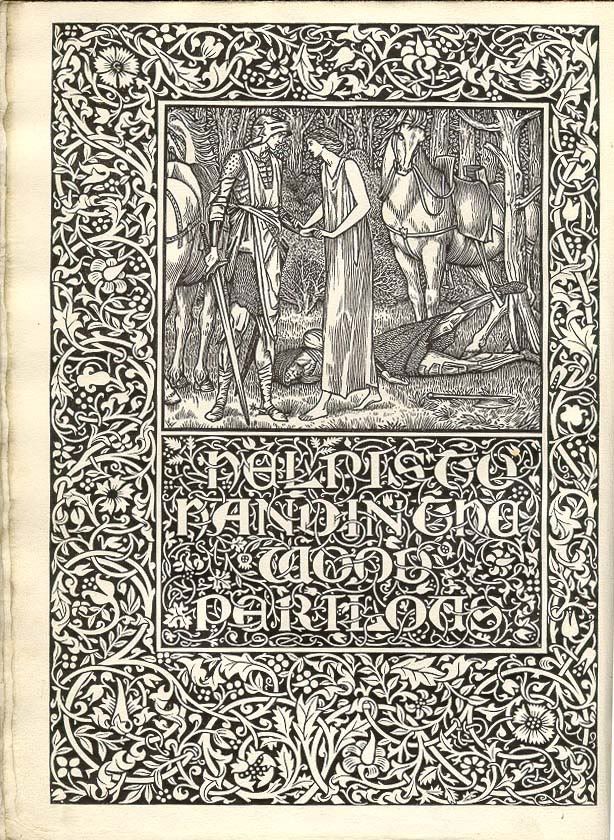
Image from Kelmscott edition of The Well at Worlds courtesy of University of Glasgow

By the way, you can purchase a gorgeous edition of George MacDonald's Phantastes through Amazon.com illustrated by Arthur Hughes, the Pre-Raphaelite painter (he and George MacDonald were close friends).

Monday, January 28, 2008

Victorian Fantasy


I finally received a copy of Bruce Edwards excellent essay "Toward a Rhetoric of Nineteenth-Century Fantasy Criticism" from the library today. It is included in a volume of essays entitled The Victorian Fantasists, edited by Kath Filmer and published by St. Martin's Press. I highly recommend the book as a whole. There are some great essays on William Morris and other great fantasy writers.

I will be doing a more in-depth review of articles from the book later, but I thought the book's introduction by David Jasper merited some attention as well. While reading it, I had a sudden epiphany: In the same way that many of my favourite fantasy writers use a sort of idealized version of the Medieval period for the setting for their novels, many of today's fantasists are using the Victorian times as a loose basis for their own fiction (the Steampunk sub-genre of fantasy literature is the best example of this--Golden Compass is the most obvious example of this genre that I can think of--if you've read Mervyn Peake's Gormenghast novels, they are also rather Victorian-inspired).

The nineteenth century is so evocative that I think we are naturally drawn to it. The world of Victorian fantasy was rich partly because of the romance and ritual that permeated everyday life. Bebe over at Peaches and Dreams made reference to this on Saturday, when she was writing about the movie Kate and Leopold. The 19th century was a time filled with ritual and thoughtful contemplation of what might today seem unimportant details. As Bebe notes, "a man spent time learning about the Language of Flowers so that when he sent (or gave) a certain lady a bouquet, his intentions would be clearly defined." Sadly, she goes on to note that "the rituals are so unlike today, where running into a supermarket for the first plastic-wrapped, turbo-preserved bundle or dialing for a teddy bear mixed assortment is commonplace." Sad, but true.

Of course, while the 19th century might seem romantic to us today, men like William Morris who actually lived through it were already bemoaning the rapid changes of the industrial revolution. I suppose it's all a matter of perspective. Do you think fantasy writers in the future will be inspired to write about our generation? Perhaps. I suppose you could say that the Harry Potter series is an example of this, but the stories are so infused with Medieval elements that I think it's difficult to see them as being very contemporary. In any case, I think both the middle ages and the Victorian era will continue to hold a great deal of romantic power over readers as well as writers. How could they not?

Saturday, January 26, 2008

Prologue to William Morris' The Earthly Paradise


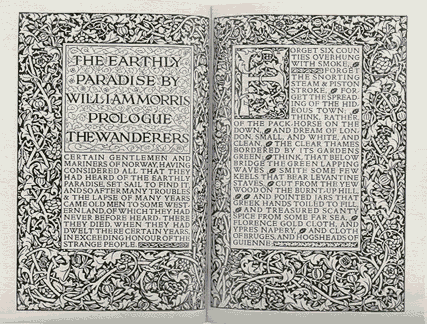
I often write about William Morris' designs and prose works, but today I thought I'd include a small exctract from his most beloved poem (and this site's namesake), The Earthly Paradise.

Written between 1868 and 1870, The Earthly Paradise was Morris' most successful work. Originally published in four parts, today it is usually sold as one volume (my 1905 edition is 445 pages!). Luckilly, the poem is made up of twenty-four long narrative poems that are tied together in a framework similar to Chaucer's Canterbury Tales (you will recall that in the Canterbury Tales, the travelers entertain themselves by taking turns telling stories while on a pilgrimage, so it's actually quite easy to read.

In The Earthly Paradise, a group of "gentlemen and mariners of Norway," lured by the prospect of discoverying a mythic Earthly Paradise, have become stranded on an island in the middle of nowhere, where they discover the descendants of a group of Greeks who landed there long ago. Together, the islanders and Norse strangers gather each month for a year, and tell lovely stories from ancient sources--Greek and Norse. Thus, the poem is also divided by month (with two stories, one Norse, one Greek for each month of the year).

The poem is highly entertaining and very easy to read (there's some archaic language, but overall it's modern english).

What follows is a small extract from the prologue to The Earthly Paradise. In this section, Morris is asking his readers to seperate themselves from the reality of their modern lives and to try and imagine the world of Geoffrey Chaucer's time, in which his poem is set:

Forget six counties overhung with smoke,
Forget the snorting steam and piston stroke,
Forget the spreading of the hideous town;
Think rather of the pack-horse on the down,
And dream of London, small and white and clean,
The clear Thames bordered by its gardens green;
Think, that below bridge the green lapping waves
Smite some few keels that bear Levantine staves,
Cut from the yew wood on the burnt-up hill,
And pointed jars that Greek hands toiled to fill,
And treasured scanty spice from some far sea,
Florence gold cloth, and Ypres napery,
And cloth of Bruges, and hogsheads of Guienne;
While nigh the thronged wharf Geoffrey Chaucer’s pen
Moves over bills of lading—mid such times
Shall dwell the hollow puppets of my rhymes.

If you would like to read more, the text to The Earthly Paradise is available online at The Internet Sacred Texts Archive's website. Curling up with a good book is always more fun, even if it isn't free, so if you like what you've read, you can always get a lovely hardback version. Amazon doesn't seem to have anything under $400, but Alibris has affordable copies starting $6.68!

(image courtesy of www.morrissociety.org)