
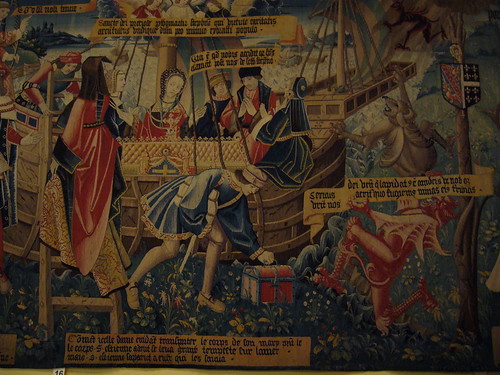
If you visit France and take a look around any of the museum gift shops, you will see dozens of beautiful tapestries for sale. Most are made in France and all of them are frighteningly expensive.
Luckilly, before I went to Paris I discovered a couple of great tapestry retailers. If you are looking for quality tapestry designs from your home, The Tapestry House is probably the best resource available. They are recommended by the New York Times. If you are looking for reproductions of larger tapestries, such as the Unicorn tapestries, this is the place to go.
Although I love smaller design firms like Charles Rupert, this is definitely the most affordable place to find tapestries and they get their products from the same place that smaller design firms do (from the factories that weave them). Most of their products are made in France and they are identical to the tapestries sold in pricey giftshops. Those tapestries that are not woven in Europe are made in the United States.
If you are on the lookout for smaller tapestries, The Tapestry Standard is another great website. They carry a wide variety of designers--including (of course!) William Morris. They sell a lot of the smaller products that you will find in museum giftshops, such as pillows. Also, if you are interested in modern and casual designs, Tapestry Standard has a multitude of patterns to choose from.
Tuesday, June 17, 2008
Tapestry Resources


Tuesday, June 10, 2008
Sanderson Fabrics
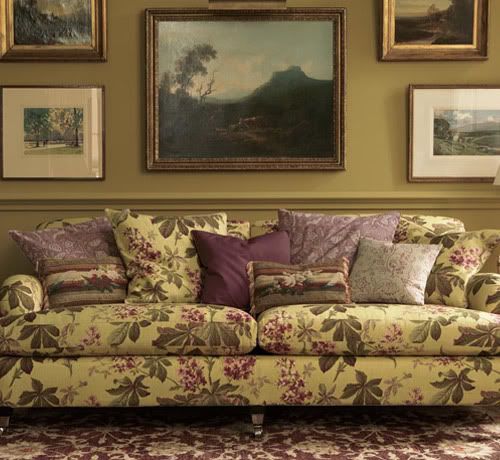
This lovely living room has been decorated using Sanderson's beautiful floral fabrics. If the designs seem familiar, it's because their patterns are copied or "adapted" by a number of other design firms. I suppose imitation is the sincerest form of flattery!
Sandersons is one of the oldest and best respected names in interior decorating. The company was established in 1860 as a firm specializing in interior design and decorating. Later, in 1923 Arthur Sanderson & Sons was awarded the Royal Warrant as Purveyors of Wallpapers to the King. In 1955 the company was again awarded the Royal Warrant to supply wallpapers, paints and fabrics to Queen Elizabeth II and the company continues to supply the Queen today.
Sanderson produces a wide variety of decorating materials, but they are best known for their floral wall papers and fabrics. Until recently, Sanderson had an exclusive copyright on William Morris' wallpaper and textile designs. In fact, Morris and Company's original designs were purchased by Sanderson some time ago and the Morris and Company website is actually a subsidiary of Sanderson's parent company, Walker Greenbank. The Morris and Company website is a great resource where you can find everything from decorating fabric to heritage paint colours.
Today you can purchase William Morris' designs from other companies, but Sanderson's are still recognized as the best quality. Their fine fabrics are guaranteed to last for years.
images courtesy sanderson-uk.com
Friday, April 4, 2008
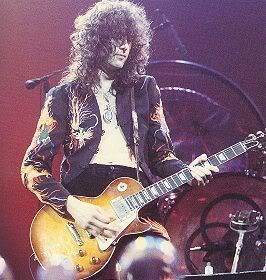
Rocker Jimmy Page will be Keeping his Morris Tapestry for Now
Several of you asked about what Jimmy Page's William Morris tapestry (designed by Edward Burne-Jones and woven at William Morris' shop) sold for at auction last month. I've been checking back at Sotheby's regularly and it turns out that it didn't sell.
Although many other items in the auction sold for several times their value, the tapestry failed to sell for its reserve price, and will remain in Zeppelin guitarist Jimmy Page's extensive collection of Pre-Raphaelite art.
Page purchased the tapestry back in 1978 for $80,000 and is only the third person to have owned it. He put it up for auction because the mammoth art piece (it's 24 feet wide) is too heavy for him to hang on the oak panelings at his new mansion near the Thames. Perhaps he will be lending it to a museum since he can't display it at home.
For more info, check out the Guardian's report.
If you'd like to see what the other items in the auction sold for, you can take a look at Sotheby's website. You'll need an account, but it's worth signing up just to look at all the beautiful artwork they have!
Thursday, March 20, 2008
Petition on Behalf of William Morris Gallery
Edward Burne Jones' Holy Grail Tapestry (discussed in yesterday's post) is set to go to auction this evening. It's presence at the auction has caused quite a stir, and fans of William Morris' art have decided to use the recent media publicity that the auction has generated in order to give attention to the plight of the William Morris gallery.
The BBC reports that today as the Morris and Company tapestry goes to auction at Sothebys for £1 m pounds, a petition containing 11,000-signatures will be presented to the Waltham Forest Council, asking them to increase opening hours and hire more staff.
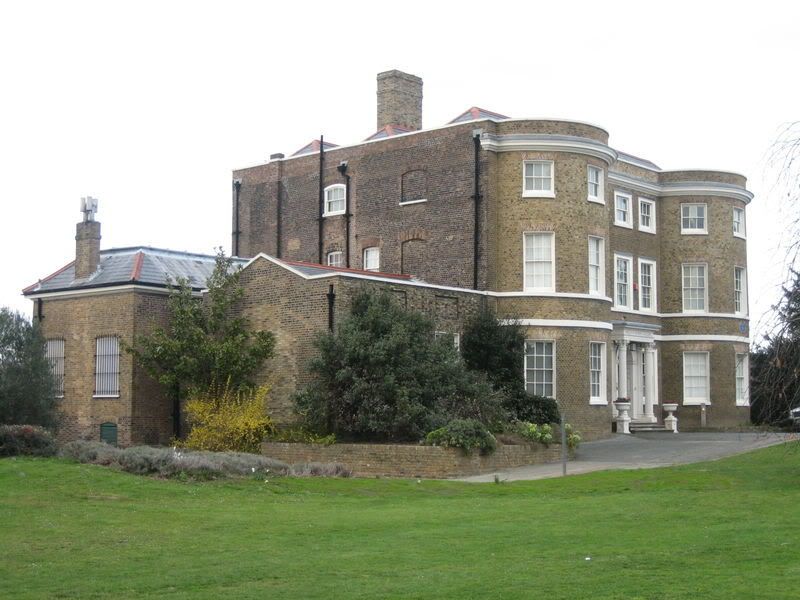
William Morris was a leading figure in the Arts and Crafts movement, known for his writing as well as his contributions to the art world. The museum and gallery is located at Walthamstow in what was Morris's family home from 1848 to 1856. The museum has been open since 1950 and contains £60 m worth of his work.
Unfortunately, the museum's hours have been drastically reduced in recent months, and the museums long time curator was sacked by the Waltham City Council because they felt it wasn't worth paying the money to keep him. I can understand why people in North America might not fully appreciate William Morris' contributions to the art world, but it seems hard to believe that the city council in Waltham--where Morris grew up, can't grasp the importance to keeping a museum dedicated to his work. I certainly hope that the petitioners are successful. I signed the online petition a couple of months ago.
In closing, I would like to extend my apologies to anyone who was trying to access my blog this morning! I was trying to switch over to publishing on a custom domain, but it didn't exactly work. I think I actually did it correctly, but it takes a day or two to update the DNS, and I really don't want to have to wait that long. I've learned my lesson...do stuff like that at night!
Wednesday, March 19, 2008
Led Zeppelin and Pre-Raphaelite Art
It turns out that gifted Led Zeppelin guitarist Jimmy Page has a thing for Pre-Raphaelite art! I read the news on Pre-Raphaelite Sisterhood yesterday and decided to do some more research into Jimmy Page's art collection.
I can't say that I'm that surprised...if you've ever listened to Led Zeppelin's music, you've probably noticed that the band was heavily inspired by Medieval/fantasy themes. Lead singer Robert Plant's favorite book was the Lord of the Rings and it's evident in their music. A number of their songs reference material from Lord of the Rings, including "Over the Hills and Far Away," "Misty Mountain Hop," "Battle of Evermore," and "Ramble On", with "Ramble On" being the most explicit.
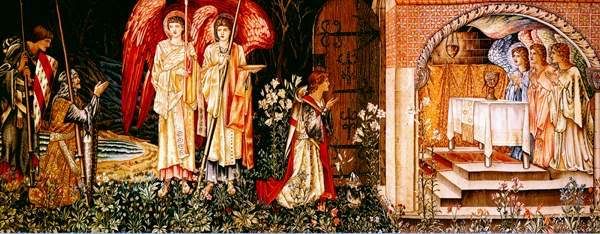
Jimmy Page has stepped beyond admiration for the medieval and has become an avid collector of Pre-Raphaelite art (including at least one painting by Dante Gabriel Rossetti). All of this has come into the news in the last couple of days as Page plans to auction one of the tapestries in his collection at Sothebys--the final scene from Edward Burne Jones' Holy Grail Tapestry (pictured above).
The piece is expected to fetch around $2 million at auction. It was originally designed by Sir Edward Burne-Jones and woven by Morris and Company's tapestry weavers. It took three weavers a full two years to complete. **edit**I guess it depends on who you ask. The New York Times reports that the 24 foot wide tapestry actually took eight men two years.
According to Page's art dealer-to-the-stars, Paul Reeves, (who has many hats, it appears--he also designed clothing for the Rolling Stones and Beatles, but has been a full time art dealer since 1976) Page is forced to sell because the wood panels on his Thames Mansion are too weak to support the tapestry. It seems more likely that he is in financial trouble, since he also plans to sell a gigantic set of Arthurian round table and chairs, and two sideboards at the same auction.
source: cbc.ca
Monday, February 18, 2008
Bullerswood Carpet
I hope everyone had a good weekend! I'm feeling a bit better today and I've had some down time to browse through one of my favourite books on William Morris before I have to return it to the library!
As you know, I love textiles. I'm particularly fascinated by carpets because they say so much about a home. I think it says a lot about changes in modern society that today we tend to fill our homes with nondescript beige carpets, whereas in the past carpets were works of art that could tell a lot about the owner.
William Morris began experimenting with carpets shortly after moving to Kelmscott House, Hammersmith in the 1870s. Today, Hammersmith carpets can be recognized immediately by the hammer and capital "M" found alongside the border (I couldn't find an image of this, unfortunately). Although originally designed at Hammersmith (hence, Hammersmith carpets), Moris moved the operation to Merton Abbey in 1881 so that he could take advantage of the larger looms available there. On nice days, Morris would take the carpets outside and spread them on the ground so that he could get a sense of what they looked like all together! (Todd, 50). The designs were exquisite, but extraordinarily expensive, like many of William Moriss' other accomplishments.
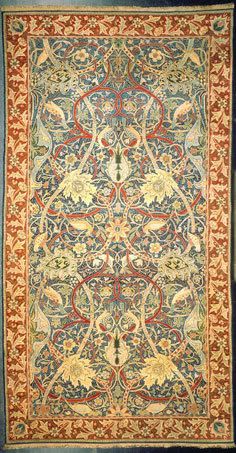
Of his carpet designs, the Bullerswood carpet is probably my favourite. The design is versatile and goes well with a variety of decorating schemes. It was made for John Sanderson, a wealthy wool merchant who had invited Morris and Co. to refinish his home. Some historians believe that Morris wove the carpet himself, since he had given specific instructions that nothing was to be put into the house that he had not made himself. Nevertheless, many today believe that Morris' talented assistant John Henry Dearle had a hand in creating the carpet, given the boldness of the design (Todd, 50). The carpet was coloured using only vegetable dyes. Interestingly, it's been very well preserved because it is so large that the Victoria and Albert Museum has not been able to have it on permanent display, which has helped preserve the colours from light damage.
images courtesy of Victoria and Albert Museum.
Source: Victoria and Albert Museum.
Also see Pamela Todd. William Morris and the Arts and Crafts Home. San Francisco: Chronicle Books, 2005.
Friday, February 1, 2008
William Morris Forest Tapestry
I've been waiting on pins and needles (pardon the pun) for my trellis kit to arrive! In the meantime, it never hurts to drool over the other interesting things out there. Today I've been reading about tapestries.
One of William Morris' greatest legacies was his revival of a number of art forms that were on the brink of extinction at the end of the 19th century. Chief among these were his fabulous tapestries. 
The design went on to become one of the most popular in the history of Morris and Company. The original now hangs in the Victoria and Albert Museum.
I've also included a photo of Beth Russell's fabulous needlepoint adaptations. I usually can't stand animals in needlepoint designs, but I think these come across as regal and decidedly un-tatty. I especially love how she's displayed them! If you're interested in making one of these cushions yourself, you can purchase it through her website, or find the design in her book, Traditional Needlepoint
In closing, it's been really fun to read everyone's posts on seven things about themselves! Thanks for joining in!
Wednesday, January 23, 2008
Redesigned Vintage Clothing

There are a lot of great articles all over the internet about how to recycle your used clothing. I see so many people on the streets every day that have found ingenious ways of recycling old tees (it was quite a trend a couple of years ago). Teens, in particular, really love the opportunity to take part in the design of their clothing. Overall, I think the popularity of companies like Preloved and others is a real sign of people's desire for new choices as consumers (and producers!). People seem to relish the innovation required in order to make use of vintage clothing items--and if they don't have time to do it themselve, many are choosing to purchase items from companies like Preloved. Jennifer Welch, owner of Virginia Wells, a San Francisco-based vintage clothing store, recently made the connection between her business and a growing Arts and Crafts movment in an interview with Green Living Online :
"In the late 19th century, the Arts and Crafts movement was a backlash against
the mass production that had come about after the Industrial Revolution. Today,
with increased technology and globalization, people want more integrity,
simplicity and utility - we yearn for grass-roots accessibility and to see
the individual instead of the advertising
campaign."
Monday, January 21, 2008
The Quilts of Gee's Bend
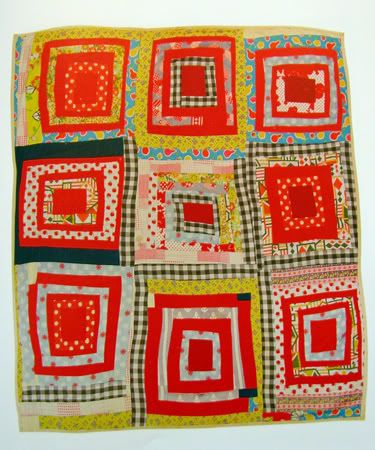
I was lucky to have the opportunity to examine the quilts of Gee's Bend several years ago for a professor who was writing a book on the history of cotton. It was incredible story about how a group of women were able to transform quilt making from a survival skill that helped their families through long winters into a viable and thriving business that significantly augmented their household incomes.
The isolation of the Gee's Bend community was a significant factor in preserving the aspects of African culture that made the Gee's Bend quilts unique. Many of their methods of quilt making had been preserved since the time when African Americans had first arrived in Alabama as slaves:
…the appliqué tradition that flourished in the American South was brought over
by slaves from Benin (formerly known as Dahomey), West Africa. In the Benin
tapestries, stories from oral tradition and history are illustrated with
appliquéd figures. Animals are used to symbolize kings or central figures of
proverbs or folktales. The influence of Benin appliqué tradition on the Bible
quilts of Harriet Powers, an ex-slave from Benin has been firmly established by
scholars, particularly in her technique and animal symbolism. Another intriguing
aspect of Harriet Powers’ quilts is the merging of Christian religious symbols
with the African cosmology of the Bakongo people. (Fry, 12).
Sewing is almost my heart. I just love to sew and quilt quilts with my mother.
When I was six years old I started helping her sew. I went on to making quilts
and learned how to make all the different quilts she knowed how to make:
Bricklayers, Monkey Wrenches, Grandmama’s Dream, Grandmother’s Choices, Coat of
Many Colors, Broken Stoves, Wild Geese Chases, Cross Cut Saw, Stars, Sweeps, and
Bear’s Paws. We growed up making those quilts. I don’t know why they spell out
from but we made ’em through our own parents. I guess she did learn from her
mother, ‘cause her mother was making quilts and quilting ‘em, too, when I knowed
my grandmother.
I growed up sewing. I used to make all my kids’ clothes. I
never bought clothes. I made the clothes(Callahan, 194).
Tuesday, December 4, 2007
Beth Russell Needlepoint

Monday, October 1, 2007
Linens
I received some of these Williams Sonoma toile napkins for my wedding shower. They are durable and lovely and come in both blue and claret. I've had a hard time finding everyday napkins to use with my Spode Blue Italian China and these are just perfect. You can order them online at: http://www.williams-sonoma.com/products/l890/index.cfm?pkey=cLINPRNI


