Showing posts with label waterhouse. Show all posts

Monday, October 18, 2010

Karen Elson's Pre-Raphaelite Inspired Music Video "The Truth is in the Dirt on the Ground"

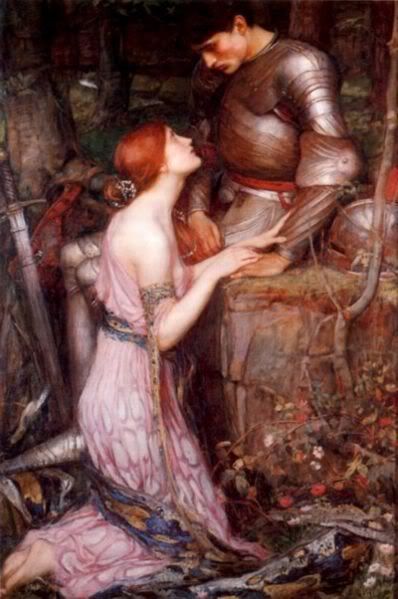
Fashion model Karen Elson is making her foray into the music business with her new album The Ghost Who Walks. She recently released the album's first music video, for the track "The Truth is in the Dirt on the Ground." The video is chock-full of Pre-Raphaelite references. There are numerous allusions to Pre-Raphaelite paintings here - I was particularly reminded of Waterhouse's Ophelia (because of the Queen Anne's Lace) and his Lady of Shalott (of course, parts of it are also quite reminiscent of Kate Bush's "Wuthering Heights"). With her vibrant scarlett locks, Elson has long been described as a Pre-Raphaelite beauty - I'm glad to see that she's embracing the label in her new music video! 


Apparently, the song was inspired by an obituary for Eartha Kitt. I did a little digging around, and it looks like Elson was referring to a quote from the New York Times obituary for Kitt: "I'm a dirt person...I trust the dirt. I don't trust diamonds and gold." 


The song is quite catchy, and the sound, which her husband, Jack White of the White Stripes, describes as "folk country gothic" is very appealing. I've been humming it ever since I saw the video this morning. 

A special thanks to Grace from The Beautiful Necessity for posting the video on her blog!

Wednesday, September 23, 2009

J.W. Waterhouse Garden of Enchantment


A new exhibit of J.W. Waterhouse's work will be held at the Montreal Museum of Fine Arts from October 1, 2009, to February 7, 2010. The exhibit will feature the largest-ever retrospective of works by John William Waterhouse (1849-1917). J. W. Waterhouse: Garden of Enchantment will be the first large-scale exhibition of Waterhouse’s work since 1978, and promises to be the first expo to focus on works from throughout his lengthy artistic career.

The Montreal Museum of Fine Arts will have at least eighty works of art, on loan from public and private collections throughout the world. Garden of Enchantment will also feature a number of Waterhouse's sketches in oil, chalk and pencil (many of these works have not been seen in public since Waterhouse's death). The exhibition has been organized by the Groninger Museum, the Netherlands, with the collaboration of the Royal Academy of Arts, London, and the Montreal Museum of Fine Arts. The exhibition, which premiered at the Groninger Museum, will also be presented at the Royal Academy of Arts (June 27 to September 13, 2009), and the Montreal Museum of Fine Arts (October 1, 2009, to February 7, 2010).

It sounds like Garden of Enchantment will be a fabulous exhibit. I would desperately love to get a chance to see these works in person!

For more information, visit The Montreal Museum of Fine Arts website

Thursday, June 11, 2009

John William Waterhouse Exhibit in Montreal


The Montreal Museum of Fine Art has just announced an exhibit of John William Waterhouse's work, set to open this fall.

The exhibit will run from October 1, 2009 through to February 7, 2010. The show was organized by the Groninger Museum in the Netherlands, with participation from the Royal Academy of Arts in London and the Montreal Museum of Fine Arts. It is expected to be the largest collection of his work ever on display, with paintings gathered from public and private collections across the globe. A number of the works have not been seen since Waterhouse's own lifetime.

I've been so excited by the recent increase in Canadian exhibits focusing on Pre-Raphaelite and Pre-Raphaelite related artists. Now, if only they'd do one in Edmonton! (Perhaps when our new Edmonton art gallery opens?).

For those of you living in the UK (or lucky summertime visitors), the exhibit can be seen at London's Royal Academy of Arts from June 27 - September 13, 2009.

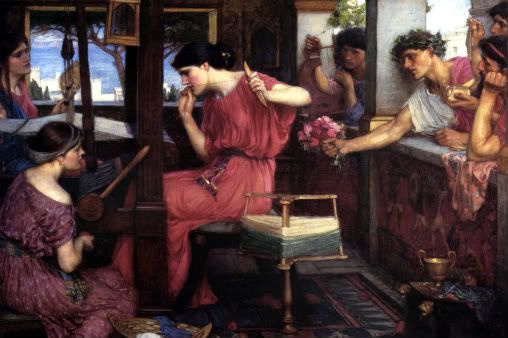
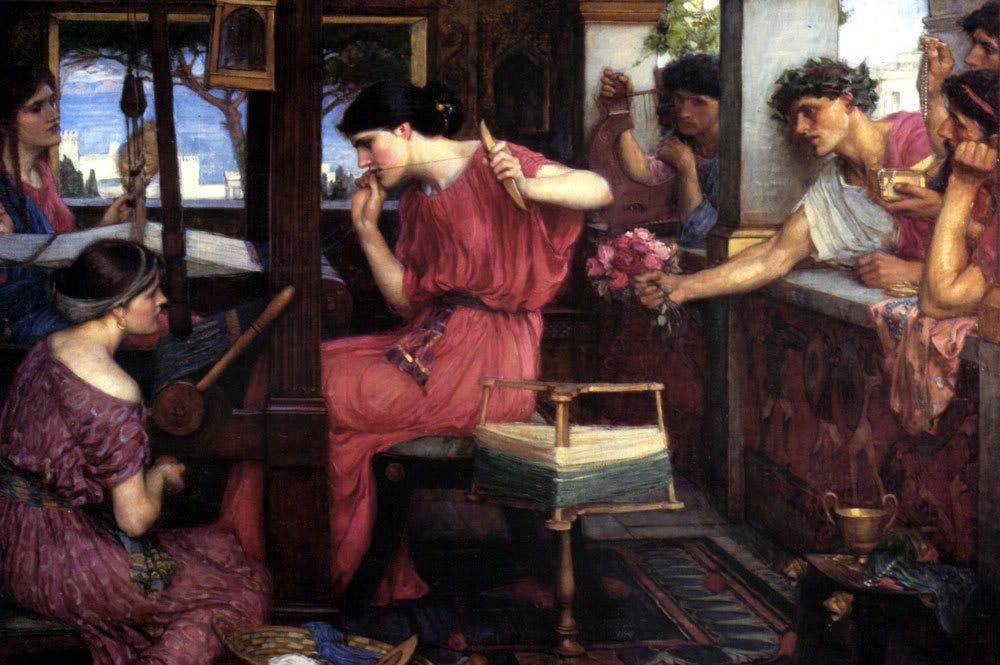
Image: Penelope and the Suitors, John William Waterhouse, 1912

Monday, August 18, 2008

Possessed: Announcing a New Pre-Raphaelite Musical!


What do you get when you combine Pre-Raphaelite art, an infamous love affair, and music? Possessed is a new musical that examines the life of Jane Burden, from her discovery by Dante Gabriel Rossetti to her meteoric rise to become one of the most popular and iconic models of her age, almost omnipresent in the paintings of the Pre-Raphaelites, particularly those of Dante Gabriel Rossetti. Possessed focuses on the relationship between Jane, her husband William Morris ("Topsy") and Rossetti. The full cast also includes Bessy, the Morris's housekeeper, Lizzie Siddal, Mr. Carter (the foreman of Morris & Co.), and Jane and William Morris’ two daughters, Jenny and May.

Playwright Teresa Howard became inspired to research Jane’s story following a William Morris exhibit at the Victoria and Albert Museum back in 1996. For Possessed, Howard (who has written a number of other plays) has teamed up with composer and arranger Steven Edis, who has written and arranged music for numerous theatre and television productions.

Not surprisingly, art plays a central role in the production. During the course of the musical, stained glass windows depicting the tale of Tristan and Isolde are constructed on stage, symbolising the close relationship between art and life and alluding to the link between the story being played out on stage and the story of Tristan and Isolde.

The musical was presented on April 27 at the Oxford Playhouse and was a great success, generating a great deal of interest in the project. Hopefully full scale production of the musical will begin at the end of next year...I can’t wait!

To learn more about this production, visit the The musical's official website. For up to the minute news and information, visit their blog, Putting it Together.

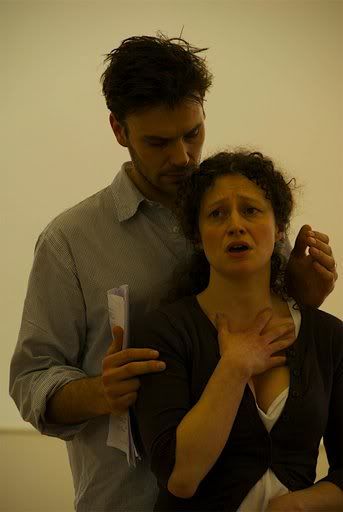
Rehearsal photo of Anna Francolini as Jane Morris and Joseph Millson as Dante Gabriel Rossetti

Rehearsal Photo by Charles Girdham © 2008, reprinted with permission of Teresa Howard

Thursday, June 26, 2008

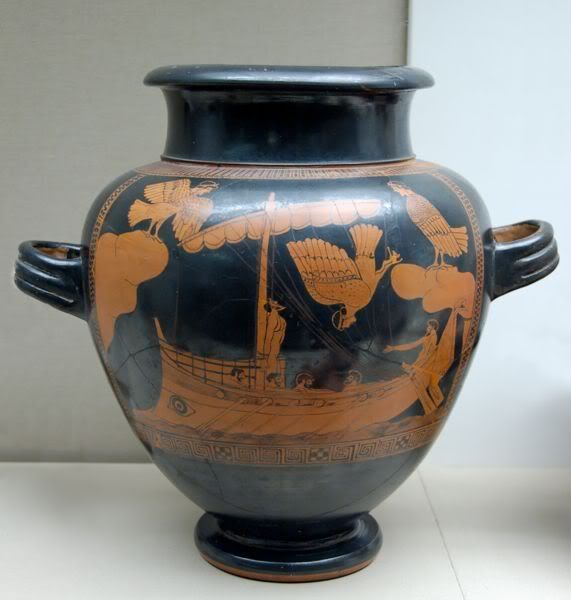
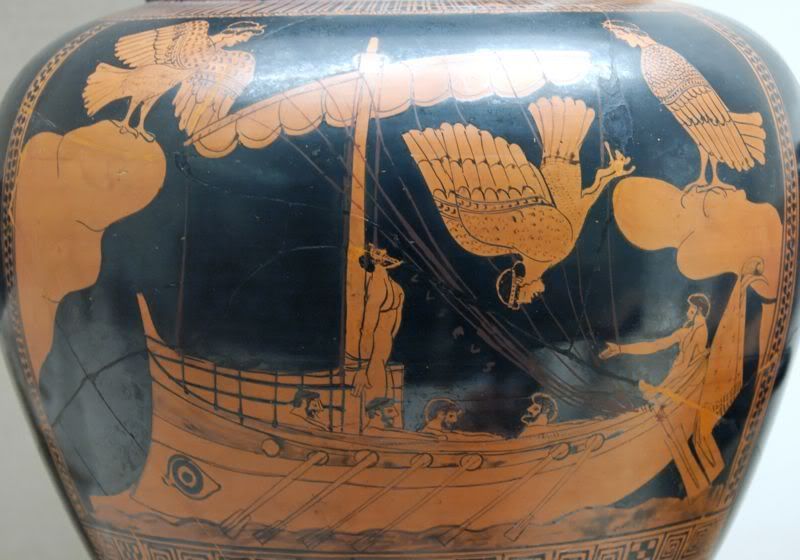
Greek Vase from British Museum depicting Ulysses and the Sirens

In Greek mythology, the Sirens were depicted as creatures with the heads of women and the bodies of birds. The Sirens lived on an island and lured unwary sailors to their rocky shores with their songs (Virgil V, 846; Ovid XIV, 88). They feature prominently in the tale of Ulysses/Odysseus and also of the Argonauts (you will recall that it is Orpheus who saves the Argonauts from the sirens by playing his own tune, whereas Ulysses takes a more direct approach--plugging his sailors' ears and having himself tied to the mast).


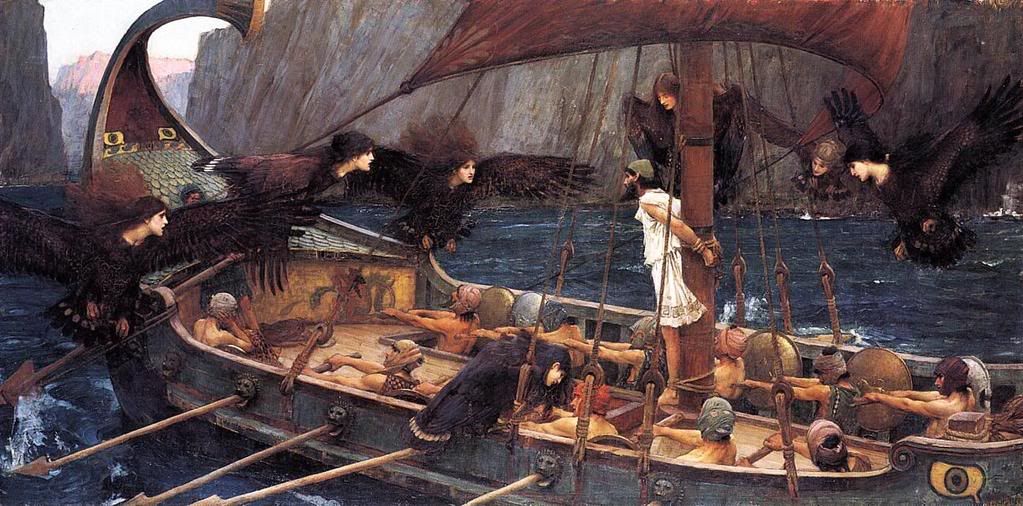
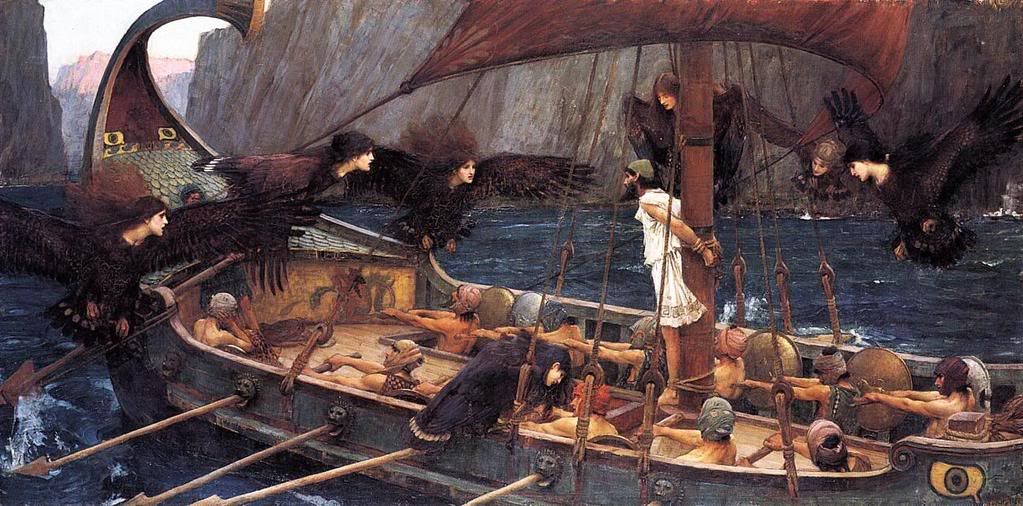
This red Attic vase from the British Museum (ca. 480-470 BC) is thought to have inspired John William Waterhouse's painting of Ulysses and the Sirens. There are a few differences, for example Waterhouse shows 6 Sirens in his painting, whereas this vase appears to only depict 3 (I have not seen the vase myself, so I'm not sure what's shown on the opposite side). But after examining the two pieces a little more closely, I think it's undeniable that Waterhouse used the vase as inspiration for his artwork.


You can tell from this close up that although Waterhouse has chosen to update the Sirens' hairstyles, he has copied their body shape directly from the vase. Likewise the form of the boat and the oars certainly evokes the style depicted on this piece of pottery. You'll also notice that they eyes that decorate the boat are common to both renditions.


images courtesy wikimedia commons.

Tuesday, June 24, 2008

John William Waterhouse takes on Ulysses and the Sirens

Yesterday I noted that The Times was quite critical of Herbert James Draper's 1909interpretation of Homer's Sirens. Perhaps that is because 18 years before his painting was exhibited, John William Waterhouse had shown his own pictorial representation of Ulysses and the Sirens.


Unlike Draper, who leaned rather heavily on artistic license, Waterhouse was extremely careful to include specific details from the story that only would have been apparent to someone with more intimate knowledge of history. For example, as Australia's National Gallery has pointed out, the faces of Homer and his men, their clothing and helmets, and the boat's design have all been inspired by genuine artifacts.

Furthermore, you'll recall that critics were outraged that Draper portrayed the Sirens as mermaids. But when Waterhouse's rendition of the scene was exhibited 18 years before, critics noted that Waterhouse was one of the first artists to portray the Sirens as bird-like figures, something he might have noticed on a trip to the British Museum, which houses an ancient Greek red figure vase depicting the Sirens as birds.

I appreciate Waterhouse's version because it transports the viewer into the story of Ulysses and has a very clear narrative quality. Draper's portrayal seems to be telling a different tale altogether, but it's so lovely that I can hardly fault it. Both are lovely.

Monday, April 7, 2008

La Belle Dame sans Merci

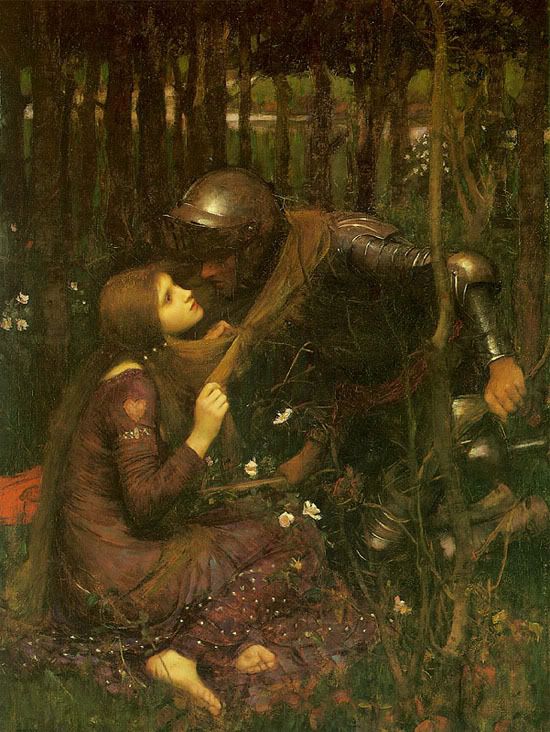
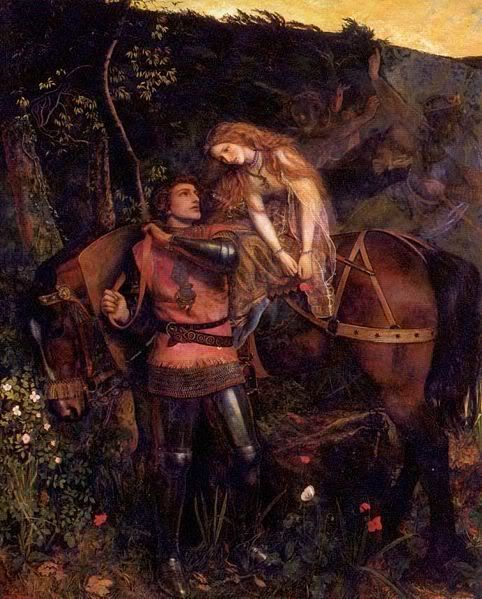
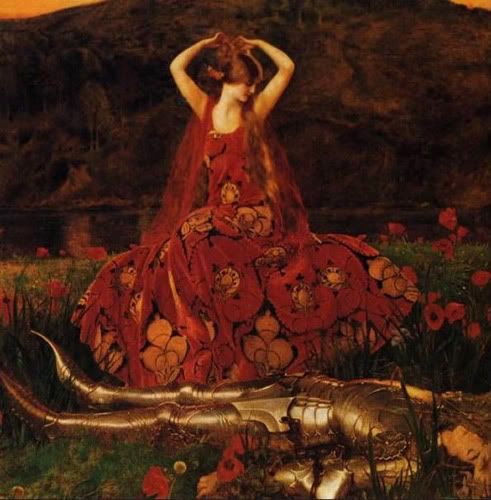
Of all John Keat's poems, La Belle Dame sans Merci had by far the most influence on the Pre-Raphaelites. The symbolism and sadness in the poem, combined with its femme fatale leading lady must have made it difficult for them to resist! It has inspired numerous paintings. The most popular versions are probably those by John William Waterhouse, Arthur Hughes, and also later versions by Frank Cadogan Cooper and Sir Francis Bernard Dicksee. Walter Crane and Henry Maynell Rheam also did works inspired by the poem.

The poem describes an encounter between a knight and a mysterious lady. The story opens with a description of the knight "palely loitering" among the hillsides. He has had the misfortune to encounter a lovely woman with wild eyes, whose managed to convince him that she desperately needed his help, when in fact, she was merely plotting to ensnare him. As the knight lies sleeping in her lair, he dreams of the other "pale kings and warriors" that had been lured to her resting place. They warn that "La Belle Dame sans Merci hath thee in thrall!" When he wakes, he's wandering in the countryside. The moral of the story? Don't talk to strangers! Especially when they are lovely damsels in distress!

John William Waterhouse was inspired by Keat's poem and unveiled this painting in 1893. He certainly captures how convincing the lady is--she doesn't look like she could harm a fly. The knight is completely drawn in.


Arthur Hughes' knight looks quite taken with the lady. He doesn't seem to notice the ghosts of other lost souls trying to warn him away!


Sir Frank Dicksee painted his rendition in 1903. This painting is quite popular these days! I seem to see it in every calendar featuring knights, ladies and the like. I do love the mystical femme fatale quality that Dicksee has captured. The knight is certainly transfixed.


Frank Cagadon Cowper's version (1926) of La Belle Dame is strikingly modern in comparison to the other paintings. Look at the lovely textile designs on her dress! Interestingly, his knight is perhaps the most historically accurate.


Finally, on a lighter note, here's a 1920 Punch cartoon featuring the knight and lady. She's clearly more interested in her reflection in the knights armour than she is in seducing him. Hmm.

Tuesday, March 25, 2008

Pre-Raphaelite Visions of Penelope


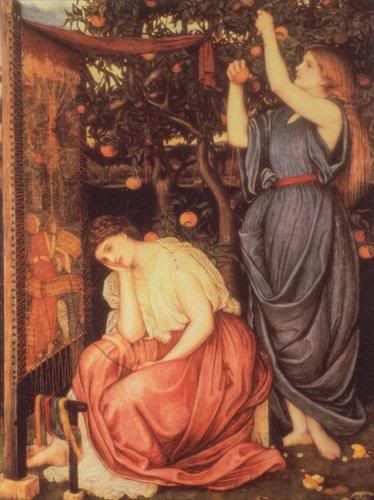
JR Spencer Stanhope was a follower of Pre-Raphaelite Painter Edward Burne Jones. I love his paintings, though critics have often noted that he was not as subtle an artist as Burne Jones. He is noted for his bold use of colour, which unfortunately doesn't come across in this copy of his painting Penelope, which he finished in 1864. The Pre-Raphaelites were a rather close knit circle, as you may have noticed, and Stanhope was actually Evelyn de Morgan's uncle!

Stanhope's Penelope is one of those paintings that has a real way of capturing the emotions of characters in a classic tale. As you will recall, Penelope was the wife of Odysseus in Homer's Odyssey, who waited patiently for him throughout his long travels. She is often associated with the virtue of faithfulness, since she remained dedicated to her husband in spite of the hoards of suitors that dogged her in his absence.

Penelope waited 20 long years for Odysseus to return from fighting the Trojan War. Stanhope's painting portrays Penelope weaving Odysseus' burial shroud (which you will notice is nearly complete--Peneope had promised her suitors that she would remarry once it was complete--but she tricked them by removing some of the stitches every night).

After Penelope's trickery is revealed, she meets an old beggar (Odysseus in disguise, of course). After a long talk with him, she concludes that she will only marry the man who can re-string Odysseus' bow and use it to shoot an arrow through 12 ax handles. After a series of dismal failures on the part of her suitors, Odysseus of course succeeds in a triumph somewhat reminiscent of Arthur's feat of removing the sword from the stone. He reveals himself to be her long lost husband, and after a final identity test, they are reunited.

This painting seems to capture Penelope's sadness quite well! The painting emphasises her emotions, whereas JW Waterhouse's portrays her dedication to her craft. In my opinion his painting is somewhat more artful than it is thoughtful. I love both paintings, but in this case, I think Stanhope's Penelope is my favourite.