Showing posts with label william holman hunt. Show all posts

Friday, January 7, 2011

The Poetry of Drawing: Pre-Raphaelite Designs, Studies and Watercolours

Those of you living in the UK (or visiting) are in for a real treat this month. From January 29, 2011 to May 15, 2011, The Birmingham Museum is hosting what promises to be "the largest survey of Pre-Raphaelite drawings and watercoulours ever staged." The museum has assembled works Birmingham Museum & Art Gallery’s world-class collections, together with important pieces from public and private lenders, including some works by D.G. Rossetti, William Holman Hunt and Edward Burne-Jones that have never previously been exhibited. The exhibit, entitled The Poetry of Drawing, will place special emphasis on the important role that drawing played in the Pre-Raphaelite movement.

The Poetry of Drawing will include pieces from the most prominent members of the Pre-Raphaelite movement, including all the original members of the PRB, Elizabeth Siddal, Edward Burne-Jones, Frederick Sandys and Simeon Solomon. Later artists, such as Aubrey Beardsley, who were influenced by the Brotherhood are also included, as are the Arts and Crafts contributions of William Morris, William de Morgan and Florence Camm.

For those of you who are unable to attend, the exhibition's curator has created an illustrated volume entitled Pre-Raphaelite Drawing. The book will be published by Thames and Hudson. I would love to see this exhibit in person, but if I don't get the chance, I will definitely be looking into the catalogue!

For more information and ticket prices, please visit the Birmingham Museum's exhibition website.

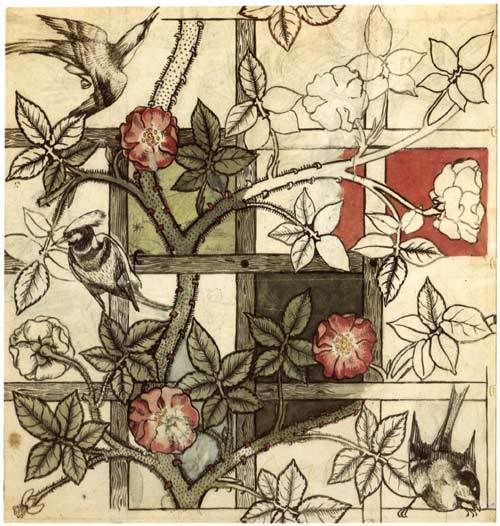
Image above is William Morris' sketch for his Trellis wallpaper design.

Monday, August 10, 2009

BBC 4 The Pre Raphaelites

For those of you living in the UK, the BBC has released a 3-part documentary series on the Pre-Raphaelites to coincide with Desperate Romantics. Since Desperate Romantics is rather short on historical context, be sure to watch the documentary alongside the costume drama, especially if this is your first introduction to the Pre-Raphaelites.


The documentary, entitled The Pre-Raphaelites: Victorian Revolutionaries, features author Jan Marsh (author of Pre-Raphaelite Sisterhood) and a number of other art historians discussing the PRB's rise to fame, their landscape art and the eventual commercialisation of their work.

I really enjoyed the series, although I found it a little annoying that they kept insisting that the Pre Raphaelite Brotherhood somehow "sold out" when they began to find a market for their art. The series really pushes the notion that the Pre-Raphaelites were somehow the first artists to commercialise their work (and that this was a betrayal of their earlier, nobler ideals). Artists and writers have always wanted to profit from their work. It's pure romantic fantasy to imagine that there was some golden age of art where everyone indulged in art for art's sake without an eye toward profits. The PRB simply lucked out by being in the right place at the right time, and they took advantage of the technology that was available to them. I'm quite sure that if Sir Joshua Reynolds had lived through the Victorian era, he too would have been hawking his lithographs right alongside the former members of the PRB. You will remember that even the socialist William Morris was a businessman! It seems very hard for the BBC to conceive of the possibility that one might simultaneously be a romantic revolutionary and hope to pay the rent.

For those of you living in the UK, several of the episodes are available in streaming video online through the BBC Pre-Raphaelites mini site.

Episode 2, which covers the Pre-Raphaelites approach to landscape art, will be aired again on August 11 at 10:00 pm.

Monday, August 3, 2009

Desperate Romantics - First Impressions

I finally had a chance to watch the first two episodes of BBC's Desperate Romantics with Javier last week. We both really enjoyed it. Overall, I found it highly entertaining (and yes, it was quite accurately described by its producer as "Entourage with easels"). The production was a bit weak on the historical front, but I suppose this was done by the writers to broaden the appeal of the series.

The series focuses on the early years of the Pre-Raphaelite Brotherhood and follows their rise to fame.

I was pleasantly surprised with the casting, particularly that of Lizzie Siddal. The actress who plays Lizzie not only resembles Siddal a great deal, but she also does an excellent job of bringing life and pathos to the character. John and Effie Ruskin are also well-cast, and are more developed than I had anticipated, although the endless speculation about what was wrong with their marriage always gets to me--honestly, nobody has any idea what the problem was (biographers seem to constantly return to the idea that Ruskin was disgusted by Effie's body hair, but how could they know?). Nevertheless, much like the rumours about Michael Jackson, I suppose this gossip is just too juicy for scriptwriters to pass up.

Unfortunately, the characterization of most of the other major players is rather simplistic, though it is in keeping with the rest of the shows' approach. Aidan Turner is handsome and energetic as Dante Gabriel Rossetti, if a bit one-dimensional. William Holman Hunt's character certainly seems to have drawn the short straw in terms of personality. Most biographers of the Pre-Raphaelites tend to consider Hunt a bit of a blowhard, but he's painted with such a broad brush in this production that it borders on the ridiculous. I hope that the writers will add some nuance to his character in the remaining episodes. Perhaps the most promising character so far is that of John Everett Millais, who is played by Samuel Barnett. Millais' character is quite endearing, and it looks like we will be seeing more of him in tonight's episode.

The character I could sort of do without is Fred Walters--a fictional hanger-on that is meant to function as a bit of a window into the lives of the PRB. He's sort of an amalgamation of a number of real-life members of the brotherhood, but I really wish that they had included William Michael Rossetti in the story instead. William Michael has always seemed quite interesting to me, and he certainly did a great deal to contribute to the visibility of the Brotherhood. I suppose the writers felt that adding in another member of the Rossetti family would rob Dante Gabriel of some of his mystique, but I digress.

Overall, I'm definitely enjoying the series. It's so nice to finally see the lives of the Pre-Raphaelites dramatized! Desperate Romantics may fall a bit short on historical accuracy, but the story of the Pre-Raphaelite Brotherhood is so inherently exciting that the show can't help but be enormously entertaining.

I'd be extremely interested to hear from others who've had a chance to see the first few episodes. What were your first impressions? Were you pleased or disappointed? Do you think the show will revive interest in the Pre-Raphaelites?

Tuesday, April 14, 2009

Sin and Salvation: Holman Hunt and the Pre-Raphaelite Vision

For those of you in the Toronto area who have not yet had the chance to visit the Art Gallery of Ontario's current Pre-Raphaelite exhibit, there's still time! "Sin and Salvation: Holman Hunt and the Pre-Raphaelite Vision" will be running until May 10, 2009. Sixty of William Holman Hunt's paintings are on display at the exhibit, including Isabella and the Pot of Basil, The Awakening Conscience and The Light of the World.


In addition to the paintings, the museum is also displaying the costumes that Hunt and his family used to pose for artworks (Hunt himself used to enjoy dressing up while he was painting--I saw a great photograph of him a while ago in full safari getup while he was painting The Scapegoat). It sounds like an amazing exhibit. I only wish I lived closer to Toronto!


For more information on the exhibit, please visit the Art Gallery of Ontario's website.

Sunday, February 8, 2009

Cast of "Desperate Romantics" announced by the BBC

The BBC Press Office has finally released the casting information for their upcoming series, Desperate Romantics. Most of the actors historically inspired TV dramas are much better looking than their historical counterparts and I'm not complaining. However, the BBC definitely took some rather extreme artistic liberties with this one.

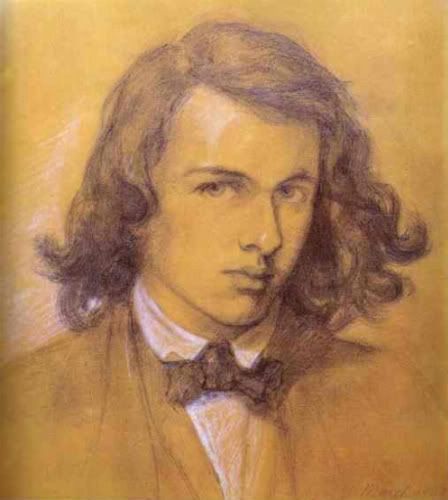
First up: Dante Gabriel Rossetti will be played by Aiden Turner. We all know that Rossetti was a bit of a lady killer, but he wasn't exactly top model material. The producers have chosen to gloss over this a bit and have chosen an impossibly attractive young man to play Rossetti. While I fail to see much of a resemblance between him and Rossetti (other than the fact that both of them have brown hair!), I'm pretty sure Rossetti would approve. After looking at his photograph, take a look at his self-portrait. Rossetti doesn't seem to have had a problem with portraying himself as more attractive than he actually was (though, in his defence I'm sure years of drug abuse had taken a toll on his boyish good looks in this photo).

Dante Gabriel Rossetti, in the flesh
Photobucket

Rossetti's self portrait:


And finally, his cinematic alter ego :
Photobucket

Correction: it's not that Aidan Turner, it's this one:
Photobucket

(And thank you to whoever pointed out which Aidan Turner will actually be starring in Desperate Romantics! A little less soap-opera-ish and a lot more believable.)

And now for the rest of the cast.

Tom Hollander (who bears little resemblance to John Ruskin--for one thing, he's a bit chubby and Ruskin was practically anorexic) will be playing Ruskin, the famous art critic and patron of the Pre Raphaelites. This casting decision still makes sense to me,though, as Hollander often plays snobby, self-absorbed types. At the same time, I hope he doesn't overdo it. Ruskin was certainly interesting, even if he was obsessed with his work and had a rather odd way of relating to women.

In more casting news, Samuel Barnett will be playing John Millais, and Zoe Tapper will be playing Effie Ruskin (who later leaves Ruskin to be Mrs. Millais).

Amy Manson has been cast as Pre-Raphaelite "stunner" Lizzie Siddal, Sam Crane as Fred Walters and Jennie Jacques will play Annie Miller. Rafe Spall will also take a turn as PRB founding member William Hunt.

All in all, I predict that the script will be frothy melodrama and the cast will be easy on the eyes. Not a problem, as far as I'm concerned. There's no denying that the Pre-Raphaelites are ripe for soap opera-esque treatment. I just hope that the series will revive public interest in the Pre-Raphaelite and Arts and Crafts movements.

Saturday, September 27, 2008

The Awakening Conscience by William Holman Hunt

Photobucket
First of all, I've been a little neglectful of this blog over the last week! I just started a new job and I've been quite busy. I have a hard time writing when I don't have the time to be inspired, but I suppose that's something I'll just have to work on!

Speaking of "uninspired," I must confess that this William Holman Hunt's "The Awakening Conscience" is probably my least favourite Pre-Raphaelite painting. By far. I've always found it incredibly ugly, since the first time I saw it. That being said, I must confess that it's a very visually arresting work.

The technicolor color scheme is jarring to the senses, like many of Hunt's pieces. The subject itself seems rather tawdry, even today! I also can't help but think that the image of the fallen woman seems hoplessly Victorian. Apparently, the work was inspired by a "fallen woman" that Hunt had attempted to guide toward the straight and narrow (unsuccessfully).

While doing a little reading about the painting in Tim Barringer's The Pre-Raphaelites, I came across a copy of the song that is on the young woman's piano. You can see the title, "Oft in the Stilly Night" on the music. I thought the words were rather interesting, and seem to add an extra element to the painting that made me appreciate it a little bit more.

Oft, in the stilly night,
Ere Slumber's chain has bound me,
Fond Memory brings the light
Of other days around me;
The smiles, the tears,
Of boyhood's years,
The words of love then spoken;
The eyes that shone,
Now dimm'd and gone,
The cheerful hearts now broken!
Thus, in the stilly night,
Ere Slumber's chain hath bound me,
Sad Memory brings the light
Of other days around me.

Do any of you like this painting? I'd be really interested to hear what others have to say about it.

Tuesday, September 23, 2008

The Original Members of the Pre Raphaelite Brotherhood

Rienzi Vowing to Obtain Justice Holman Hunt Pre Raphaelite
Last week I wrote a post about the Pre-Raphaelite that led to some questions about the original Pre-Raphaelite Brotherhood. I thought today I would write a little bit about the founding members of the PRB, and the major players among them.

Although there were seven original members of the Pre-Raphaelite Brotherhood, the founding members of the Brotherhood were really Dante Gabriel Rossetti, William Holman Hunt and John Everett Millais. These three have had the most lasting influence from among the original seven, and there work is the best known. After the idea for the PRB had been developed by Rossetti, Hunt and Millais, Rossetti invited his brother William, a clerk at the Inland Revenue Office, into the group as well. Interestingly, at the time the the Brotherhood was founded, William was neither a painter nor a serious writer. Nevertheless, he was the founding member's brother, and I suppose you can't blame Rossetti for wanting to include his family members!(Christina Rossetti was also an important part of the group, though she was excluded from the Brotherhood by reason of her sex).

Thomas Woolner, the fifth member of the PRB, was a sculptor who was introduced to the Brotherhood by D.G. Rossetti. In his biography of Rossetti, Evelyn Waugh is anxious to point out that Thomas Woolner married a Waugh (Alice Waugh). So too, did William Holman Hunt--twice. He first married Fanny Waugh, and when she died in childbirth, he married her sister, Edith. This was illegal in Britain at the time and he had to travel abroad in order to marry her!(Waugh, 35). No wonder Waugh was so interested in the Pre-Raphaelites!

James Collinson, a convert to Roman Catholicism had torrid on again/off-again relationships with both Christina Rossetti and the Catholic Church--both of which often seemed to hold far more interest to him than his painting--was the next to join. Frederick George Stephens was the seventh and final member of the original group. Stephens was a student of William Holman Hunt and his membership in the Brotherhood may have been due as much to Rossetti's superstition (a desire for a perfect seven-member group) as to any supposed artistic contribution from Stephens.

Source consulted: Evelyn Waugh. Rossetti, His Life and Works. London: The Folcraft Press, 1969.

Image: William Holman Hunt, Rienzi Vowing to Obtain Justice

Monday, September 15, 2008

Millais Self-Portrait

Photobucket
John Everett Millais painted this self-portrait when he was just 18 years old. He had already been a member of the Royal Academy of Art Schools for 7 years, having been admitted at the age of 11 (he remains the youngest person ever admitted to the Schools).

Millais' self-portrait was painted just two years before he helped found the Pre-Raphaelite Brotherhood, but the style of the painting seems light years away from the fine detail evident in Lorenzo and Isabella. I have to admit that if I didn't know who had painted this portrait, I would have had a hard time guessing who it was! Perhaps Millais was experimenting with new techniques when he created this portrait, because the brushwork seems much for "sloshy" than in his later work--or even than in his earlier work.

Tomorrow: a story from Millais' youth, and a closer look at one of his earliest masterpieces, Pizarro Seizing the Inca of Peru.

image courtesy of Tate Gallery

Wednesday, August 13, 2008

"The Scapegoat" by William Holman Hunt

The Scapegoat William Holman Hunt

As promised, this is the last of the William Holman Hunt goat/sheep series. We started with The Hireling Shepherd, and yesterday we examined Our English Coasts. Today I'll be looking at The Scapegoat.

William Holman Hunt left London for the Holy land to find inspiration for his work on January 13, 1854. When he arrived in Jerusalem, he began reading the book of Leviticus and was particularly impressed by its account of the Day of Atonement. Leviticus records how on the Day of Atonement, the Jews were instructed to take two goats and sacrifice one in front of the temple and drive the other outside of the city to its death--symbolically carrying the sins of the people away with it. Hunt immeadiately connected the tale to the story of Christ's Passion, and thought it would make a fantastic subject for his next painting.

In spite of the safety concerns in the region (in the 1850s, just like today, there was a lot of unrest around Jerusalem, but a lot less security!), Hunt set out into the countryside to start painting The Scapegoat, using the Dead Sea as his backdrop. Hunt later recorded his adventures in his book Pre-Raphaelitism and the Pre-Raphaelite Brotherhood (1905):

I suspended my painting and looked from beneath my umbrella, until suddenly the
deeshman [armed tribesmen] emerged from behind the mountain within half a
furlong of me where they halted. The horsemen had their faces covered with black
kufeyiahs, and carried long spears, while the footmen carried guns, swords and
clubs...I continued placidly conveying my paint from palatte to canvas,
steadying my touch by resting the hand on my double-barrelled gun. I knew that
my whole chance depended upon the exhibition of utter unconcern, and I continued
as steadily as if in my studio at home...

It certainly sounds as if Hunt had an exciting time! (At the very least, he was a great story teller!). I love how he portrays himself as the romantic hero.

Nevertheless, when local tensions escalated, Hunt was forced to abandon his field work to finish the painting in his studio. But in order to preserve the integrity of his painting, he took samples of the mud and salt from the Dead Sea back to his studio and purchased sheep and goat skulls and a full camel skeleton to add into the background of the painting (for more info, see this article from the Liverpool Museum about the painting). There weren't very many laws to protect animals in those days, and so Hunt took a live goat to his studio and made it stand for hours in a tray of dried mud so that he could paint it as accurately as possible. No wonder the goat looks so miserable! No word on what happened to the goat after the painting was completed.

Sadly, for all of Hunt's attention to detail, The Scapegoat was poorly received when it was shown in London. Although Hunt provided a note "See Leviticus, xvi" ('And the Goat shall bear upon him all their iniquities unto a Land not inhabited'), members of the academy complained that the symoblism of the painting was too hard to understand. Others felt that it was blasphemous to use a goat as an allegory for Christ's Passion.

Nevertheless, at least one member of the Royal Academy was impressed:

I think we shall see cause to hold this picture as one more truly honourable
to us, and more deep and sure in its promise of future greatness in our schools
of painting, than all the works of "high art" that since the
foundation of
the Academy have ever taxed the wonder, or weariness, of
the English Public.
--Academy Notes, 1856, 14.64 in Hewison
Fortunately for Hunt, the controversy didn't discourage buyers, and the painting was sold for 450 guineas.

Source consulted: Hewison, Robert. Ruskin, Turner and the Pre-Raphaelites. London: Tate Gallery Publishing, 2000.
Image courtesy wikimedia commons

Tuesday, August 12, 2008

William Holman Hunt "Our English Coasts"

william holman hunt
In the wake of the popularity of the The Hireling Shepherd, William Holman Hunt was asked by Charles T. Maud to paint another picture featuring the wayward sheep. In 1852, William Holman Hunt began work on Our English Coasts (also known as Strayed Sheep).

Hunt used the cliffs of Fairlight, east of Hastings, as the background for the work. You will recall that William the Conqueror, a Norman (French) invader, triumphed over the English forces at the battle of Hastings in 1066, forever changing the course of English history and introducing feudalism into England.

Hunt's choice of Hastings as the setting for his painting was certainly not a coincidence. Symbolism was so important to the Pre-Raphaelites that it seems very unlikely that Hunt would have chosen to portray a flock of "sheep" wandering precariously over the cliffs near Hastings if he hadn't intended to convey a deeper message. As a result, many have interpreted the painting as symbolic of fears of the French invading England. Interestingly, the Duke of Wellington, Arthur Wellesley, famed for his defeat of Napoleon at the Battle of Waterloo, died while Hunt was in the process of completing the painting.

The painting is also reminiscent of Alfred Lord Tennyson "Ode on the Death of the Duke of Wellington," especially these two lines:

Remember him who led your hosts;
He bade you guard the sacred coasts (VII, 21-22)

Whatever the deeper meaning behind the painting, it left a significant impression on art critic John Ruskin (who had defended Hunt's earlier work as well). When Our English Coasts was first exhibited, Ruskin praised the painting highly in his lecture series, The Art of England. Ruskin remarked that "it showed to us for the first time in the history of art, the absolutely faithful balances of colour and shade by which actual sunshine might be transposed into a key in which the harmonies possible with material pigments should yet produce the same impressions upon the mind which were caused by the light itself"(33.272-3).

As with Hunt's other early paintings, what is striking about this work is the near-photographic detail. The flowers and leaves in the background are done with incredible precision. Even the veins in the sheep's ears are lifelike! It's a really spectacular composition on so many levels. One of the things I really like about this painting is that it reminds us that the Pre-Raphaelites didn't just paint pictures of knights and ladies! There are so many beautiful landscapes done by artists in the Pre-Raphaelite vein that deserve more attention.

Thursday, August 7, 2008

William Holman Hunt "The Hireling Shepherd"

The Hireling Shepherd
The subject of William Holman Hunt's The Hireling Shepherd was actually taken from William Shakespeare's King Lear. In the play, the character Edgar sings a song about a shepherd neglecting its flock, and Hunt used the song as an inspiration for his work.

King Lear Act III, Scene VI.41
Edgar: "Sleepest or wakest thou, jolly shepherd?
Thy sheep be in the corn;
And for one blast of thy minikin mouth,
Thy sheep shall take no harm."

If the song is rather reminiscent of "Little Bo-Peep," it's no accident. King Lear is actually referred to as "Bo-Peep" by the court jester earlier in the play (I.iv)

Fool: Then they for sudden joy did weep,
And I for sorrow sung,
That such a king should play bo-peep,
And go the fools among.

In King Lear, the shepherd analogy is used to show that the King has been distracted from his calling as "shepherd" to his "flock."

William Holman Hunt actually wrote a letter on this subject that I found on Shakespeare Illustrated--a great website that connects 19th century paintings to their roots in Shakespeare's work.

Shakespeare's song represents a Shepherd who is neglecting his real duty of guarding the sheep: instead of using his voice in truthfully performing his duty, he is using his "minikin mouth" in some idle way. He was a type thus of other muddle headed pastors who instead of performing their services to their flock--which is in constant peril--discuss vain questions of no value to any human soul. My fool has found a death's head moth, and this fills his little mind with forebodings of evil and he takes it to an equally sage counsellor for her opinion. She scorns his anxiety from ignorance rather than profundity, but only the more distracts his faithfulness: while she feeds her lamb with sour apples his sheep have burst bounds and got into the corn. It is not merely that the wheat will be spoilt, but in eating it the sheep are doomed to destruction from becoming what farmers call "blown." (Quoted by Landow, 39).

I really enjoy the humour in this painting. At first glance, the viewer is presented with an idyllic setting--rolling hills dotted with sheep, a happy young couple, a winding stream and a field of golden wheat.

But on closer inspection, it turns out that a number of the sheep are lying on the grass, unable to get up! You can see one of the sheep on the left of the canvas is even helplessly flailing his legs! One of the sheep has wondered across the stream and is eating barleycorn (note: in King Lear, Edgar refers to the sheep being in the corn--in Shakespeare's day, corn meant barleycorn--there was no maize until after the European discovery of the Americas), which probably isn't good for him, and refers directly to the song from King Lear. The lamb resting in the girls lap is eating green apples, which are probably making him sick as well. The girl, who at first blush seemed to be relaxing in the grass happily with the shepherd boy, actually looks a little uneasy. The shepherd boy is showing her something--a death's head moth! He's also totally neglecting his work and seems oblivious to what is happening to his flock.

The painting was first exhibited in 1851.

Tuesday, August 5, 2008

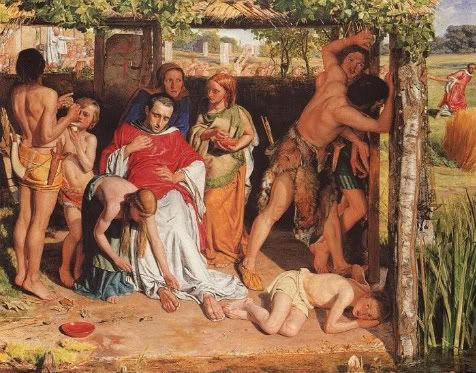
William Holman Hunt "A Converted British Family Sheltering a Christian Priest"

Converted British Family Sheltering a Christian Priest William Holman Hunt

The first painting to be exhibited after the public revelation of the meaning of "PRB" was William Holman Hunt's "A Converted British Family Sheltering a Christian Priest from the Persecution of the Druids." The title of the painting is rather self-explanatory, and like many of the early Pre-Raphaelite works, it dealt with religious themes through a rather syncretistic lens.

You might also recognize the face of the girl on the right of the priest: it's Lizzie Siddal, although Holman Hunt has portrayed her rather differently than Rossetti generally does. This painting caused an uproar when it was first displayed because of the "nudity" of some of the figures. This might have merely been a reaction to the fact that the public was now aware of the existence of the Pre-Raphaelites and did not approve of the Brotherhood.

This painting is filled with overt Christian symbolism. You can see that thorns are being removed from the priest's clothing and the women are preparing to bathe his feet--an allusion to Christ on the cross. Immediately above the priest is a red cross that indicates that the family sheltering the priest are Christian converts. A lamp burns just below, highlighting the fact that, in time, things will change for Christians in England. Grapes are being grown on the arbour above, hinting at the wine used at mass (one of the young boys on the left hand of the canvas is drinking from a chalice). At the right of the canvas, a net rests on one of the beams supporting the roof. Interestingly, while nets are symbols of Christianity (Christ made his disciples "fishers of men"), they also are a reference to the fact that this family has abandoned some key Druidic practices. The Druids believed fish were sacred and did not allow fishing.

Monday, July 21, 2008

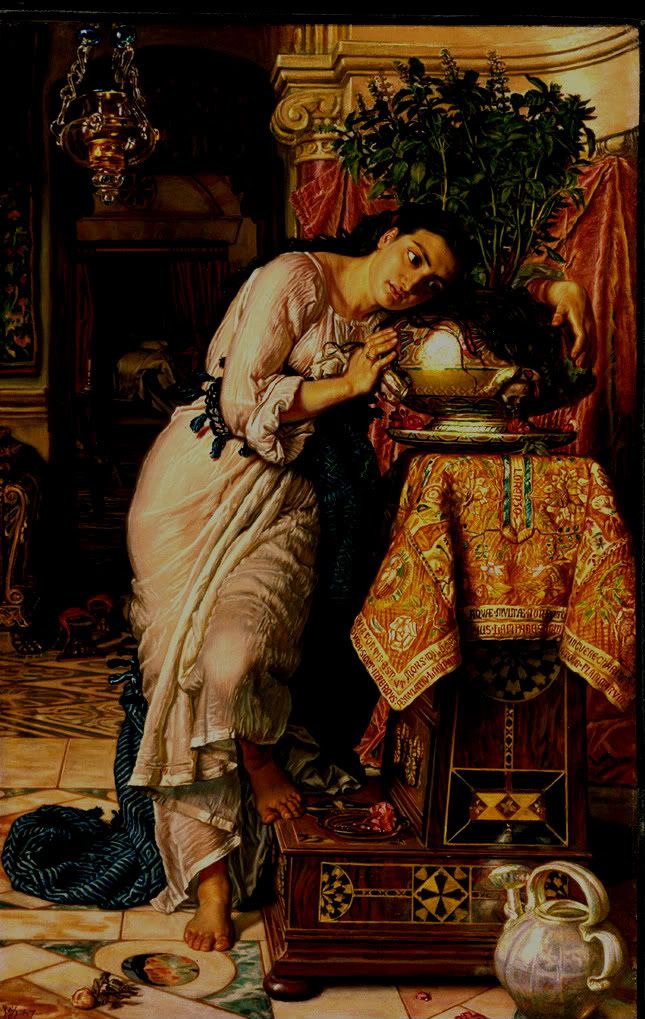
William Holman Hunt, Isabella and the Pot of Basil 1866-1868


Like Sir John Everett Millais, William Holman Hunt also chose Keat's poem "Isabella, or, the Pot of Basil" as the subject for one of his paintings. Unlike Millais, whose Lorenzo and Isabella was based on the first part of Keats' poem, Hunt chose to illustrate a scene from the second half of the poem, which was inspired by the writings of Boccaccio.

By this point in the poem, Isabella has gone to the grave yard and unearthed the head of Lorenzo from its resting place. She wraps it in a silk scarf and puts it in a garden pot, as described in the 52nd-54th stanzas of the poem:

LII.

Then in a silken scarf,—sweet with the dews
Of precious flowers pluck’d in Araby,
And divine liquids come with odorous ooze
Through the cold serpent pipe refreshfully,—
She wrapp’d it up; and for its tomb did choose
A garden-pot, wherein she laid it by,
And cover’d it with mould, and o’er it set
Sweet Basil, which her tears kept ever wet.

LIII.

And she forgot the stars, the moon, and sun,
And she forgot the blue above the trees,
And she forgot the dells where waters run,
And she forgot the chilly autumn breeze;
She had no knowledge when the day was done,
And the new morn she saw not: but in peace
Hung over her sweet Basil evermore,
And moisten’d it with tears unto the core.

LIV

And so she ever fed it with thin tears,
Whence thick, and green, and beautiful it grew,
So that it smelt more balmy than its peers
Of Basil-tufts in Florence; for it drew
Nurture besides, and life, from human fears,
From the fast mouldering head there shut from view:
So that the jewel, safely casketed,
Came forth, and in perfumed leafits spread.


Hunt used his wife Fanny, who was eight months pregnant at the time, as his model for Isabella. Their son Cyril was born a month later in October of 1866, but Fanny had a difficult time recovering her strength after the birth. She died on the 20th of December. Fanny and Hunt had only been married for 11 short months.

The painting took on a new meaning after Fanny's death. Hunt worked feverishly on the canvas, which was over 6 feet tall (73.5 x 45.5 in or 187 x 116 cm)(Hawksley, 94). I love the way that Isabella's hair mingles with the soil in the pot--it's such a beautiful depiction of her grief and her longing to be joined again with Lorenzo. Hunt would have certainly had a more emotional connection to the subject after his wife's death.

Work Consulted: The Essential Pre-Raphaelites by Lucinda Hawksley, published by Dempsey Parr.