Wednesday, December 1, 2010

Art History Carnival December 2010


Welcome to the December 1, 2010 edition of the Art History Carnival!

As the year draws to a close, I am struck by the art history community's growing online presence. When I started this blog back in 2007, I was surprised by the paucity of art history blogs on the net. I'm sure there were plenty of people out there blogging, but in those days it was difficult to find blogs unless they were ranked highly by search engines. I started the art history carnival as an attempt to connect to others with an interest in art history. A casual glance at those early carnivals will give you some indication of how few submissions I received back then! When I brought the carnival back this September, I could immediately tell how much things had changed. Over the past few months I have consistently received informative and engaging submissions. I was also pleased to have the November issue of the carnival hosted by Monica at Alberti's Window(thank you again, Monica!).

Art history - and the humanities in general - clearly have a growing presence, not only in the blogosphere, but also in new social medial like Facebook and Twitter. The art history community is thriving on Twitter, as evidenced by Dr. Ben Harvey's recent post examining the impact Twitter on art history Art History in the age of Twitter, posted at his academic blog Emanata, at Mississippi State University.

H Niyazi often uses his blog Three Pipe Problem to draw attention to the way the web can function as a transformative tool for the arts. His recent post Online Collaboration in the Humanities examines how RSS feeds and Twitter have changed the way we connect with each other to share ideas and inspiration.

It's a whole new web 2.0 world out there, and if things can change this much in three years, I can't wait to see what the future holds for the online art history community!

architecture


In this guest post for Arttrav, architectural historian Agnes Crawford takes us on a fascinating tour or the Chapel of Saint Zeno at Santa Prassede in Rome.The Chapel of Saint Zeno at Santa Prassede: mosaic revival and survival is posted at Arttrav.com

art history


H Niyazi explores the theme of the mystical landscape in Romantic art in Caspar David Friedrich and the Primordial Landscape posted at his art history blog Three Pipe Problem.

Art historian Monica Bowen, author of Alberti's Window explores the impact of art history blogging as a viable medium for teaching, collaboration and engaging the general public in her post examining art history bloggers as "les indépendents."

Just in time for Hanukkuh, Helen Webberley has written a beautiful post on Jewish silver art: filigree work posted at her blog ART and ARCHITECTURE, mainly. She writes that "many communities that could not, for various reasons, create large scale architecture, paintings and sculptures; nonetheless they could still create beautiful, small art objects. For Jewish communities after the expulsion from Spain in 1492, the art was often on religious books and ritual objects. And the medium was often silver filigree."

Susan Benford from Famous Paintings Reviewed - An Art History Blog takes her readers back in time to the art of the Aztec empire in Art History Beyond Europe: Coatlicue. This post takes a closer look at the somewhat terrifying Aztec statue of Coatlicue, a figure revered by the Aztecs, discarded by the Spaniards and revived by Frida Khalo and the Mexicana movement. It's a fascinating saga!

For a bit of fun, Corinne Reidy has created a list of the 10 Most Imitated Artists of All Time posted at Web Design Schools Guide. Can you guess which artists made the cut?

art news


Public art is seemingly everywhere, but it's abundance can also make it easy to miss. I've often been in towns I thought I knew well, only to one day "discover" a mural that I never existed before. Apparently, I'm not the only person who's had this problem! Will from Mural Locator has developed a Map of Murals to help people locate murals around the world. "Our goal is to find locations of amazing public art wall murals to share them with you and to help archive the history and importance of murals. We connect with artists, muralists, and art foundations to expand the knowledge of art." What a great idea!

Have you ever wondered about the size of the stolen art industry? (As fan of CNBC's American Greed, I confess I have). For those of you who are slightly skeptical of some of the wilder statistics on art theft that are thrown around, Mark Durney has done a post Art Theft: The 6 Billion Dollar Question that takes a closer look at where the numbers come from.

exhibits


Paul Doolan reflects on the life and works of Pablo Picasso after a visit to the museum in Picasso Visits Zurich, Again posted at ThinkShop.

Finally, a humorous musical treat in time for the holidays. Read a tribute to the Danish pianist and humorist in Piano Humour: A Victor Borge Tribute posted at Piano Street's Classical Piano Blog.

That concludes this edition. Submit your blog article to the next edition of
art history carnival
using our
carnival submission form.
Past posts and future hosts can be found on our

blog carnival index page
.


Technorati tags:

, .

Thursday, November 25, 2010

Call for Submissions for the December Issue of the Art History Carnival

The December issue of the Art History Carnival  will be posted on December 1, 2010. You can submit articles for inclusion in the carnival until 48 hours before the issue comes out (in this case, November 29, 2010). 

What kind of blog articles will be included? 
Posts covering all periods and art mediums are welcome, as are posts discussing art criticism, architecture, design, theory and aesthetics. All submissions will be carefully reviewed. 

What is a Blog Carnival? 
According to Wikipedia, a blog carnival is "a type of blog event...similar to a magazine, in that it is dedicated to a particular topic, and is published on a regular schedule, often weekly or monthly. Each edition of a blog carnival is in the form of a blog article that contains permalinks links to other blog articles on the particular topic." 

Blog Carnivals are a great way to help your blog reach a new audience and to make new friends in the blogosphere! 

Who can submit? 
Anyone, as long as you have a blog! And If you don't blog, you can submit one of your friend's articles (except they better be good--I'll be reading them!). 

Can I host a carnival? 
Absolutely! Please let me know if you'd be interested in hosting the next issue of the carnival. 

How to submit articles
You have two options:

1. Send me an email. Include the title and permalink URL of the post you are nominating for inclusion in the carnival, along with the name of the blog. Please put "Art History Carnival" in the title of your email to help me recognize it in my inbox!

2. Use the submission form provided by Blog Carnival (this is probably the easiest!). 

One final thing to keep in mind: 
To keep things current, posts should have been written after the date of the last Carnival.

Thank you for your participation! Share the news if you know someone who likes to write about art!

Monday, November 22, 2010

Did the Pre-Raphaelites Suffer from "Blurred Vision?"


This morning I came across a less-than-enthused review of "The Pre-Raphaelite Lens" in the Washington Post. In the article, Andy Grundberg criticized what he termed the "blurred vision" of the Pre-Raphaelites. And while Grundberg retained some admiration for the work done by Pre-Raphaelite landscape artists, he condemned the Brotherhood with broad strokes, arguing that "its members claimed to be interested in realism and truth" but were "far more taken with notions of fiction and theatricality."

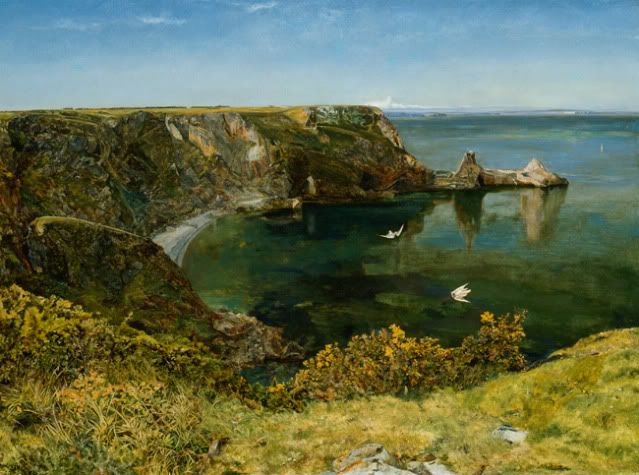
Grundberg was a photography critic for the New York Times for many years, so it's not surprising that he prefers the Pre-Raphaelites landscapes and photography to their paintings. But his criticism of the PRB is pretty standard. Many modern viewers can appreciate the work of artists like John William Inchbold (whose photograph-quality painting of Anstey's Cove is pictured here), and even Ford Maddox Brown, but remain perplexed by the romanticism of Dante Gabriel Rossetti and Sir Edward Coley Burne-Jones.

I was particularly struck by Grundberg's backhanded compliment that Julia Margaret Cameron and Henry Peach Robinson had "managed against odds to transcend their subjects' goofy origins in Arthurian legend." So now it's "goofy" to be inspired by myths and legend? Greek myth has inspired countless artists and is (quite rightly) not regarded as a "goofy" source of inspiration. Why should ancient British myths be seen differently?

Mythology is such a rich source of inspiration for artists, and it saddens me to see it dismissed off-hand. Many members of the PRB were actually very interested in a "modern" approach to art and design. They recognized that British art had become mired in convention and instead attempted to use the classics as a foundation to build from that would allow them break free from traditions that had become oppressive to artists. Even William Morris, whose passion for the middle ages is well-known, was not attempting to imitate medieval design, but to use it as a source of inspiration to create a better future.

Apparently, people today are confused that a a group that claimed to be visionary would lean so heavily on mythology and the classics for inspiration. Contemporary artists and (and their adoring critics) have the hubris to claim that they have re-invented the wheel, or are totally unencumbered by the influence of others from the past (the Young British Artists come to mind). And while this unfettered arrogance is intriguing, and can sometimes produce fascinating work, it also runs the risk of alienating the public with its hollow promise of unbridled innovation. A connection to the past and an understanding of our collective unconscious is not "goofy" - it's a fundamental part of the creative process.

Friday, November 12, 2010

Henri Matisse: A Celebration of Light and Line at the Art Gallery of Alberta

From now until February 13, 2011, the Art Gallery of Alberta will be featuring an exhibit of the works of Henri Matisse. The exhibit contains over 170 of Matisse's works, with a special emphasis on his work in printmaking. The exhibit combines works from the collection of The Baltimore Museum of Art with others from Matisse as Printmaker: Works from the Pierre and Tana Matisse Foundation, a traveling exhibition created by the American Federation of Arts and the Pierre and Tana Matisse Foundation. Many of the pieces from the Baltimore Museum of Art are recent gifts to the museum, and this will be the first time that they have been available to the public.

I'm extremely excited to see this exhibit - I can't wait to take my daughter! It's been so interesting to see what art she responds to the most. Sculpture and colorful paintings definitely seem to thrill her the most so far (she was in love with the ballet dancers from the Degas exhibit we went to earlier this year - and she was just a few months old!).   Oh, and of course she loved the AGA's "Art of Warner Bros." exhibit! Matisse's works is so colorful that I'm pretty confident it will catch her eye (now that she's a little bigger, the challenge will be getting her close enough to see, but not too close!!).

Unfortunately, I wasn't able to put up any photos of Matisse's work due to copyright restrictions (Matisse died in 1954 - so it has been a little less than 70 years since his death. As a result, there are some copyright issues since his works are not in the public domain). So, to see a few samples of works that will be included in the exhibit, visit the Art Gallery of Alberta's website for the exhibit: Henri Matisse: A Celebration of Light and Line.

Tuesday, November 2, 2010

November Issue of the Art History Carnival


I'm afraid I'm a day late (time is just flying by these days!), but I just wanted to remind everyone that this month the Art History Carnival is being hosted at Alberti's Window. There are some great articles in this issue that are not to be missed, so be sure to visit!

Friday, October 22, 2010

November Issue of the Art History Carnival to be Hosted at Alberti's Window

Photobucket
Calling all art history bloggers! I'm pleased to announce that the November issue of the Art History Carnival will be hosted by Monica Bowen at her beautiful blog, Alberti's Window.

For more information, visit her post announcing the November edition.

Monday, October 18, 2010

Karen Elson's Pre-Raphaelite Inspired Music Video "The Truth is in the Dirt on the Ground"

Fashion model Karen Elson is making her foray into the music business with her new album The Ghost Who Walks. She recently released the album's first music video, for the track "The Truth is in the Dirt on the Ground." The video is chock-full of Pre-Raphaelite references. There are numerous allusions to Pre-Raphaelite paintings here - I was particularly reminded of Waterhouse's Ophelia (because of the Queen Anne's Lace) and his Lady of Shalott (of course, parts of it are also quite reminiscent of Kate Bush's "Wuthering Heights"). With her vibrant scarlett locks, Elson has long been described as a Pre-Raphaelite beauty - I'm glad to see that she's embracing the label in her new music video! 


Apparently, the song was inspired by an obituary for Eartha Kitt. I did a little digging around, and it looks like Elson was referring to a quote from the New York Times obituary for Kitt: "I'm a dirt person...I trust the dirt. I don't trust diamonds and gold." 


The song is quite catchy, and the sound, which her husband, Jack White of the White Stripes, describes as "folk country gothic" is very appealing. I've been humming it ever since I saw the video this morning. 

A special thanks to Grace from The Beautiful Necessity for posting the video on her blog!