
When I heard news a couple of years ago that there was going to be a film version of Brideshead Revisited, I was cautiously excited. After all, there has been an acclaimed miniseries version in 1981, starring Jeremy Irons and Anthony Andrews, but never a big-screen adaptation. It's taken a while for the film to materialize, but it's finally here and set to debut in September. The other day I heard there would be tickets to see the premiere here in Edmonton in a week, and I was excited to see it. That is, I was, until I saw the trailer.
The first time I encountered Brideshead Revisited was several years ago on a quiet Sunday afternoon in Vancouver in the home of one of my English Professors, Dr. Klassen. I had heard him speak about the book and miniseries before, and when my friends and I mentioned we'd neither read nor seen the story, he ushered us into the family room to watch an episode.
From the moment I first saw the first chapter--"Et in Arcadia Ego"--it was love at first sight. At the end of term I rushed out and rented the miniseries, and in the months that followed, I read the novel, along with a number of Evelyn Waugh's other books.
What did I find so appealing about the story? Brideshead Revisited is a book that speaks a great deal about faith and loving difficult people (little wonder that my favourite book of all time is A River Runs Through It). The characters in the novel are layered individuals, which is why the new film version is likely--scratch that--CERTAIN to cause disappointment.
Brideshead Revisited was based on the reminiscences of Charles Ryder (played in the miniseries by Jeremy Irons), who befriended the aristocratic Sebastian Flyte (Anthony Andrews in a standout performance) while studying at Oxford. The two men formed an extremely powerful bond and Ryder soon became a regular guest at Brideshead, the Flytes' ancestral home. Ryder is attracted to Sebastian's fabulous wealth and privileged existence, but he is baffled by the deep ties Sebastian and his family have to the Catholic faith. Over the years, he watches as his friend Sebastian falls into the grips of alcoholism and becomes romantically involved with Sebastian's sister, Julia. But the relationship between Charles and the once-divorced Julia is severely challenged by the fact that they cannot marry in the Church.
Rumour has it that the new film version will focus on the relationship between Charles Ryder and Julia Flyte, rather than the friendship between Charles and Sebastian, which goes completely against the novel (Charles and Julia's love affair is more of a secondary aspect of the book's plot). Moreover, the trailer suggests that Sebastian's mother objects to the marriage of Charles and Julia on the grounds that Charles is not an aristocrat. In the novel Charles' social position and wealth has nothing to do with his difficulties with Julia: the Flytes' faith--not their money--is the main hurdle Charles cannot overcome.
The new film version has chosen to downplay the issue of faith in favour of a sort of teen-romance, class-warfare plot line. While this can work very well in stories like the recent film Atonement (which I loved), it somehow falls rather flat in this case. For one thing, Charles Ryder was quite wealthy in his own right (as was Evelyn Waugh, as the story is somewhat autobiographical). The only difference is that his family's money is from their own enterprise, rather than inherited. And part of the point of the book is that the Flytes (well, apart from Julia herself) are NOT snobs. Sebastian freely welcomes Charles into his circle without a second thought, and any objections Lady Flyte might have to Charles are religious, not financial.
Wednesday, July 30, 2008
Brideshead Revisited--Revisited


Tuesday, July 29, 2008
The Nazarenes--The Other Artistic Brotherhood
Thanks to a thought-provoking conversation over at Victoria magazine's forums, I once again ran across the subject of the Nazarenes in connection with the Pre-Raphaelite Brotherhood. I've read over and over again that Dante Gabriel was fascinated by the Nazarenes, but in the past I'd just overlooked it. This time I decided to delve a bit deeper into the relationship between the Pre-Raphaelites and this group of 19th century ascetic German painters.
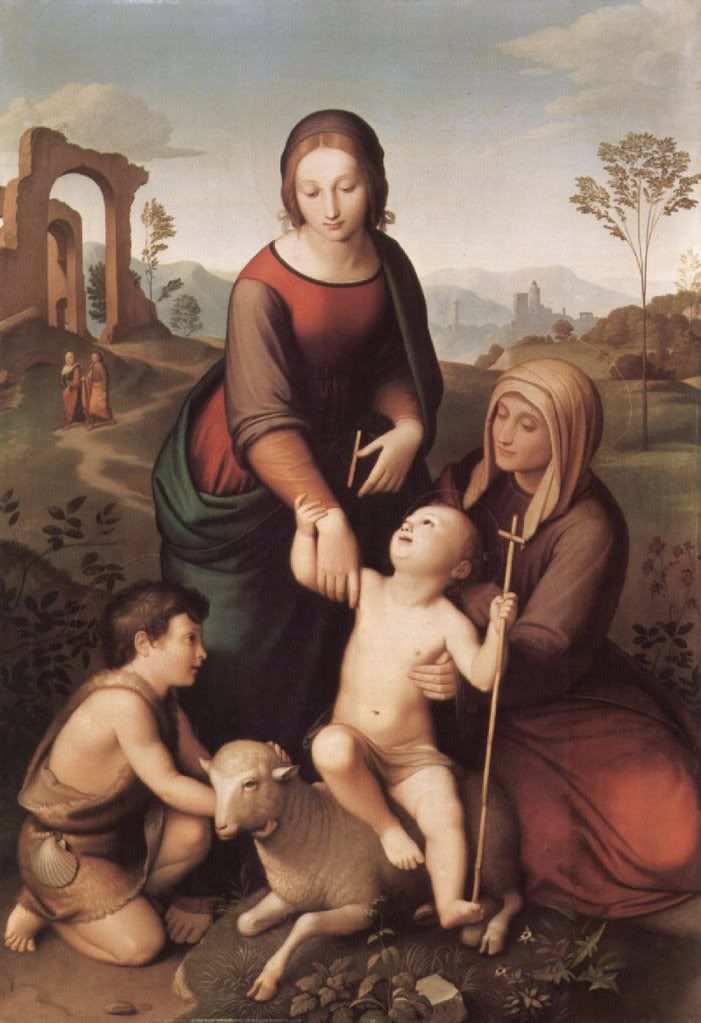
Did you know that the Nazarenes were one of the key influences on the Pre-Raphaelite Brotherhood? And no, by Nazarenes I'm not referring to the modern day religious denomination! The Nazarenes I'm talking about were a group of 19th century German artists who joined together in 1809 to form the Brotherhood of St. Luke of Vienna. The founding members of the Brotherhood were Franz Pforr and Johann Friedrich Overbeck. They got the nickname "Nazarene" because of their long hair and ascetic convictions.
Although the Brotherhood began in Vienna, Franz and Johann traveled to Rome in 1810 to live and work at the abandoned convent of Sant'Isidoro del Pincio. After arriving in Rome, the artists began fervently proselytizing art was a divine mission, elevated to the level of true faith. The Brotherhood was especially influenced by Fra Angelico, Van Eyck, Albrecht Durer and--brace yourselves--the early works of Raphael (Raphael was clearly not as popular with the Nazarene's followers, the Pre-Raphaelites").
The key tenet of the Nazarenes' philosophy was that creating art, whether it be poetry or painting--was a divine calling. This was boldly demonstrated in Nazarene arist Phillip Veit's frescos in the Villa Massimo in Rome (1819), where he chose to include three of Italy's greatest poets, Dante, Ariosto, and Tasso, next to the saints and Church fathers.
The Brotherhood of St. Luke of Vienna worked hard to purify themselves of worldly cares, and dedicated their lives to a near-monastic existence. Their devotion to simplicity and sincerity of expression was later transcribed into the Pre-Raphaelites' own doctrine:
1. To have genuine ideas to express;
2. To study Nature attentively, so as to know how to express them;
3. To sympathise with what is direct and serious and heartfelt in previous art, to the exclusion of what is conventional and self-parodying and learned by rote;
4. And, most indispensable of all, to produce thoroughly good pictures and statues.
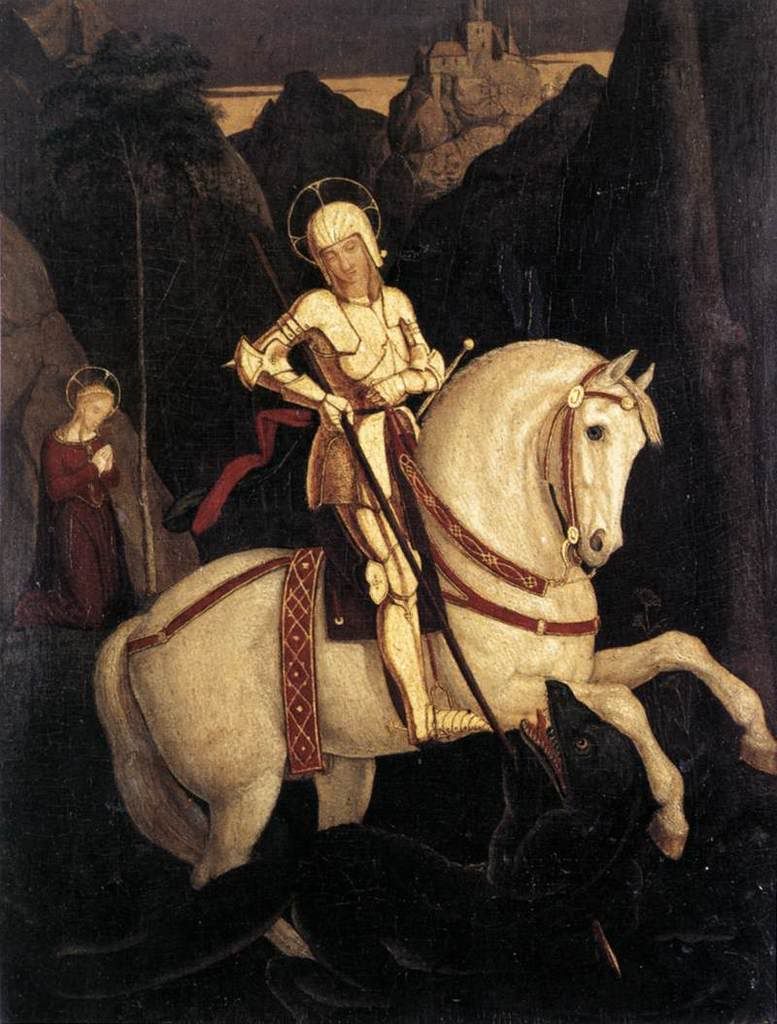 You can tell from this 1811 painting of St. George and the Dragon by Franz Pforr that, like the Pre-Raphaelites, the Nazarenes shared an interest in subjects from medieval myths and legends, although the Nazarenes were perhaps more slavishly devoted to medieval style. Even Dante Gabriel Rossetti, whose work is most imitative of the Nazarenes, was much more liberal in his use of colour.
Painting, top left: Friedrich Overbeck's Maria and Elizabeth, 1825
Works consulted: Arthistoryarchive--a great art history website with a lot of information on the Nazarenes.
Monday, July 28, 2008
More from Quinta de San Pedro Alejandrino
The Quinta de San Pedro Alejandrino and Bolivarian Museum is a tranquil oasis in the midst of bustling Santa Marta, Colombia, and a place I would recommend to any visitor. The other day I discussed the older portion of the Quinta, but I would like to take some time to examine the newer part as well.
Above you can see the building that houses the "Country's Altar" located at the end of the Flags Square at the Quinta de San Pedro Alejandrino. Constructed in 1930, it is the most recent addition to the property and definitely in better shape than the original villa.
Housed within the surrounding marble structures (which were constructed even more recently) is the Bolivarian Museum of Contemporary Art, which has a fine collection of art from all around Latin America. Most of the art has a "Bolivarian" theme and is related to themes of the Spanish conquest, or liberation from colonial rule.
In case you are wondering, the ants you can see on the outside of the building were part of an art installation--not a permanent aspect of the structure! (I accidentally stumbled into a storage room filled with paper-mache ants--kind of creepy! I really don't like bugs--even giant paper bugs!).
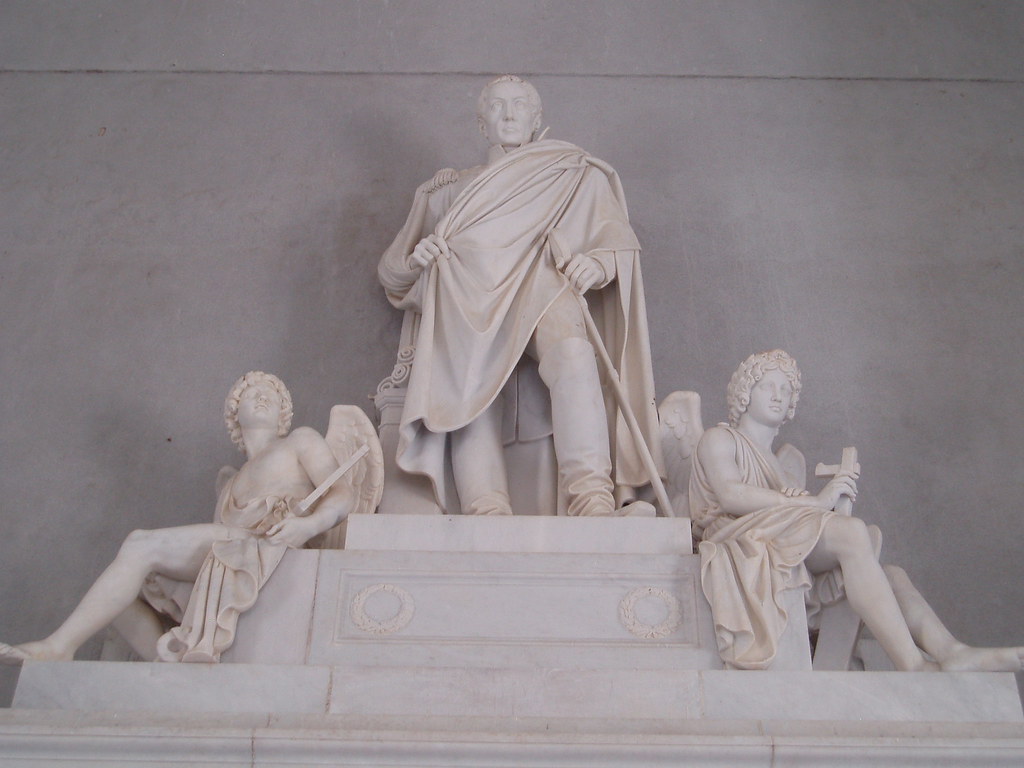
Here we can see the top portion of the "Country's Altar," which depicts the ideals on which Colombia was built. Simón Bolívar is shown at the top. The other figures represent justice (left) and work (right).
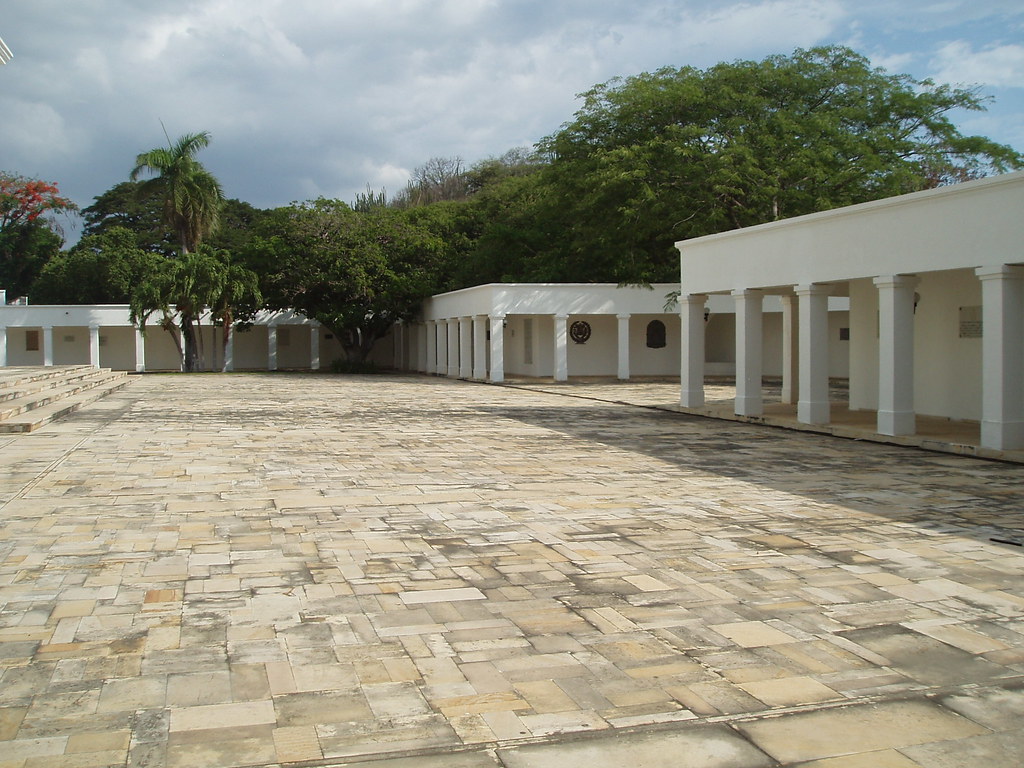
Another view of the courtyard.
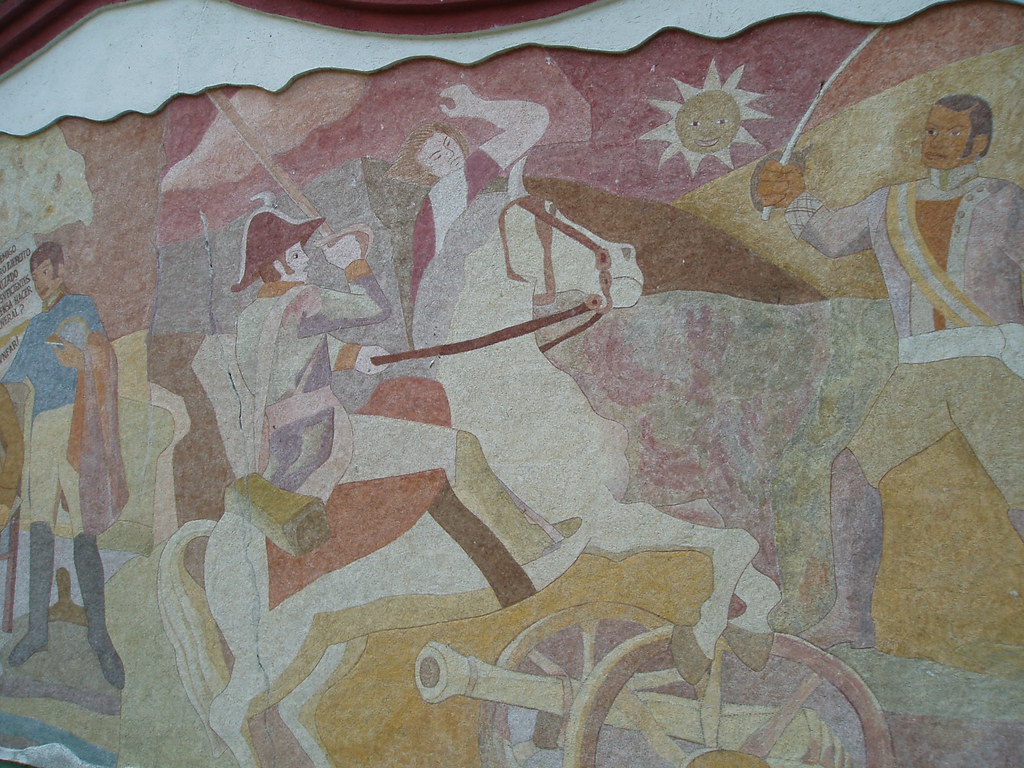
The mural below was painted in 1998 and is located on a wall just outside the courtyard. It depicts various scenes from the life of Simon Bolivar. The mural is probably almost 100 feet wide and recounts numerous episodes from Bolivar's action-packed life. Here we can see the Liberator (seated on horseback) fighting bravely against the Spanish.
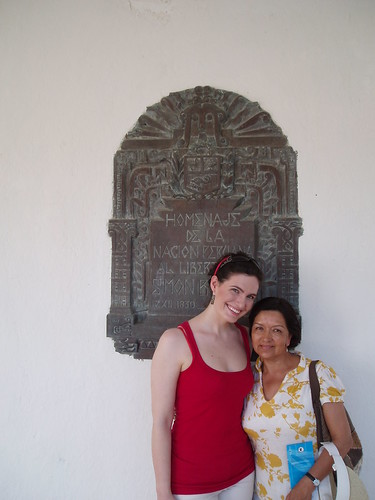
All of the countries that were liberated (or partially liberated) by Bolivar donated plaques to commemorate the construction of this monument. Here's a picture of Peru's donation (and of me with Aunt Carmen!).
I really loved seeing all the beautiful colonial architecture at the Quinta, but this newer part was beautiful as well. You could really tell that Santa Marta has invested a lot in making the Quinta de San Pedro a great tourist attraction. Our guide told us that the city of Santa Marta regularly holds benefits and other charity events in the museum and on the grounds. There is definitely a sense of "living history" here!

Saturday, July 26, 2008
Bits of Paradise from across the Blogosphere
One of my favourite things about blogging is that it introduced me to a whole world of beautiful people and things I might have otherwise missed. It's so easy to go through life without taking time to enjoy all the beauty there is in this world, but blogging forces me to slow down a little and take time to appreciate the little bits of paradise all around us. I saw so many beautiful posts this week that I decided to make a little link post featuring some of my favourites.
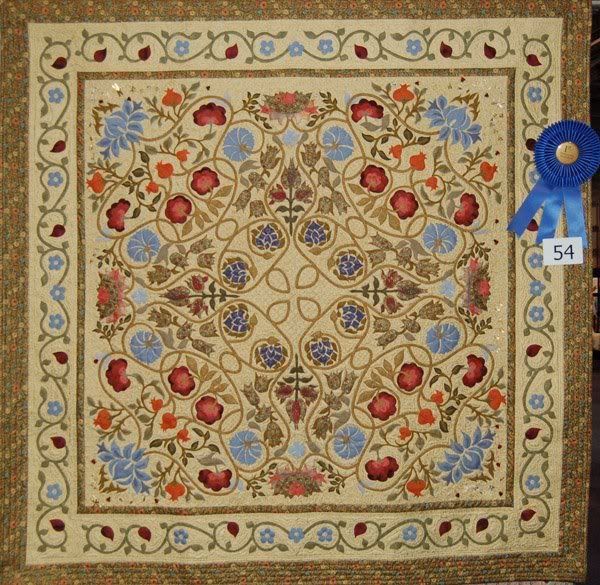
I'm always fascinated by the beautiful works of art so many of you create. I did a post a while ago on Michelle Hill's beautiful William Morris-inspired quilts, and I just discovered the other day that she has her own blog, William Morris in quilting. Be sure to visit her blog to catch a glimpse of her latest projects! (Right now Michelle is busy producing a book on Morris that will be coming out in 2009).

 Valerie at Acorn Moon is a spectacular artist in her own right. But she did a great interview on her blog last week with illustrator Patricia Papps that I really enjoyed. Papps' art is inspired by William Morris, Art Nouveau, and Egypt...can you tell? Papps illustrates a lot of children's books--I'd love to get my hands on one, her artwork is so beautiful and imaginative--two things I think are key to illustrating books for children.
Friday, July 25, 2008
Life with iphone
My dear husband picked me up an iphone 3G yesterday, and I have to say I was thrilled. Believe it or not, the iphone is my first cellular phone EVER. It's not that I'm against cellphones, I've just never really wanted/needed one enough to get one. Now that I'm doing more blogging, though, I thought the iphone would be a perfect tool for working on the go.
For those of you who weren't aware of it already, the first generation of the iphone was not available in Canada due to some problems with Canada's leading wireless carrier, Rogers. In fact, Apple even threatened to pull the iphone 3G from Canadian stores at the beginning of this month because Rogers refused to offer an unlimited data plan to Canadian customers (for those of you who are not intimately acquainted with the capacity of Canadian wireless carriers to rip-off customers, they are a virtual/literal mafia that have been price gouging defenseless Canadian customers for years--another of the main reasons it's taken me this long to get a phone).
What I love about the iphone so far:
1. The touch screen keypad. This is actually a common complaint among reviewers of the iphone, but because I'm not used to regular cell phones key pads, I find the touch sceen easier to use.
2. The sleek design. I guess it's a given, but the phone is gorgeous and the display is easy to read and understand, even for someone like me who knows nothing about phones.
3. The precise mapping technology. Okay, so it's INCREDIBLY disturbing my phone can pinpoint the side of the BUILDING I live in using google maps (I'm looking at it as I type). But it's also really useful! You can get directions anywhere so easily it's not even funny. It's sort of pointless for me, since I don't drive and we have OnStar, but oh well. It's awfully cool. Maybe I can use it when I'm walking!
4. It's cheaper and does more! Now there's less reason than ever to buy an ipod touch.
5. The Stocks application rocks. Okay, so I don't even have a penny inveseted in the stock market at this time, but this application is easy to use and beautiful. I'm hooked.
Of course, me being me, although I'm in love with my iphone, I have a long list of improvements I would like to make (even after only a few hours of use). My biggest beefs with the iphone?
1. My number one frustration with the iphone would have to be the lack of copy/paste features.
I was really hoping to do a lot of blogging with my iphone, but without the ability to copy/paste, it simply takes too long to do any serious blogging (just try copying an url without copy/paste!), or even emailing. Apparently I am not alone in being frustrated with this aspect of the iphone, as this great post on macworld testifies. I don't really know what on earth apple was thinking when they left this feature out. Copy/paste is pretty much essential for folks who are heavy net users(the number one reason I bought the iphone in the first place).
What is apple doing about this? Not much. This has apparently been a major complaint since the first iphone was released. And while a third-party developer has created an application to copy text within the iphone's "note" application, this still doesn't solve the problem for those of us who want to be able to copy text on the web or within emails (the iphone won't let you transfer text within applications).
2. No external keyboard/mouse option. There are times when you want to be able to type on a keyboard and copy/paste with a mouse. If I could use a bluetooth external keyboard and mouse with my iphone, it could actually replace my laptop for pretty much everything. I understand they want to minimize clutter, but I really don't get why apple is not doing this.
3. Landscape/widescreen feature only works in some applications. You've probably seen that the iphone has a "widescreen" feature that self-adjusts to allow you to view webpages and video in widescreen by simply turning the screen. Cool, right? Well, it's nice, but it only works with certain applications. For example, while you can view the internet in widescreen, most of the menus are only visible in the vertical (narrow) view.
4. There's no video recording or zoom on the camera. I didn't expect it, but it would have been really nice to have, and a number of other new phones from Nokia, Samsung, LG and Motorola do this.
5. The battery doesn't last long in 3G mode. About 3 1/2 hours, to be precise, if you're just surfing. Working at a normal pace, with some phone calls thrown in and taking a few breaks, it could probably realistically last you all day. I've seen some users suggest turning off the 3G when you aren't using it to save battery power.
Bottom line? The iphone is beautiful and functional, but it won't be replacing your laptop any time soon.
iphone photo courtesy of apple.com

Thursday, July 24, 2008
Quinta de San Pedro Alejandrino in Santa Marta
One of the highlights of our trip to Colombia was seeing the Quinta de San Pedro Alejandrino in Santa Marta (a quinta is sort of a big farm in Spanish). The villa is the site where Simón Bolívar--known in Colombia as the Liberator--lived out his last days. For those of you who are not familiar with Bolívar, he holds a place in Colombian history somewhat akin to George Washington in the United States. The home is actually known as the "Sanctuary of the Motherland," and it has been well-preserved--by Colombian standards. The site is a gem that contains numerous artifacts from Bolívar's time and is definitely a must-see.
A shot of the family at the Villa. From left to right: My Father-in-Law, Fabio, Aunt Carmen, Me and Javier
The original building dates back to the 17th century. Since it was the last place Simón Bolívar lived, it has historical significance for the modern nations he liberated from Spain--Colombia, Venezuela, Ecuador and Panama. The main house is a Bolivarian museum that is worth seeing, though the preservation of many of the items is depressing (as a historian I wanted to cry when I saw such valuable original artifacts left to rot in the tropical heat and humidity).
A shot of the interior courtyard
The estate also houses a sugar mill, which has been more or less dismantled, although the outside of the structure is still lovely. One wonders why the government hasn't provided any funding for a proper restoration of the property, but then, this is Colombia we are talking about after all.
San Pedro Alejandrino Villa is open to the public from 9:00 a.m. to 5:00 p.m. Be sure to get a guide! Our guide, Manuel, was amazing--he knew all about the history of the villa and gave us lots of time to take pictures, which is always a plus. Overall I was really impressed, despite my disappointment with the museum's lack of attention to historical preservation. Oh well, you can't have everything!


Wednesday, July 23, 2008
Julia
While I was at home a week ago with my mom in Olympia, she shared one of her favourite films with me: Julia. She's told me about the movie with me my entire life, so I was really excited to finally get a chance to see it!
Julia, starring Jane Fonda and Vanessa Redgrave, is a story about the lifelong friendship between author Lillian Hellman and "Julia." It is a tale of two best friends who grow apart over the years but whose friendship with each other always remains a key factor in both their lives. When Julia, played by Vanessa Redgrave, goes to Vienna to study medicine before the outbreak of World War II, she becomes involved with a group of students who are attempting to overthrow the Nazis. Jane Fonda stars as Lillian Hellman (you may remember Hellman as the author of The Children's Hour and The Little Foxes), alongside Jason Robards as Dashiell Hammett (author of The Maltese Falcon).
It was only after watching Julia that I did a bit of research and discovered that this film (which I would venture to say is not very well known today) was actually a critical and box office success at the time of its release. The film was nominated for 11 academy awards and won 3, including best supporting actor (Jason Robards), best supporting actress (Vanessa Redgrave) and best adapted screenplay (Alvin Sargent). Fred Zinnemann, who piloted projects such as A Man For All Seasons (1966) and High Noon (1952) directed.
I've always wondered why this film wasn't released on DVD sooner, and I suppose there are a couple of key reasons. The first is that when this film was came out, it was made controversial by the fact that Vanessa Redgrave and Jane Fonda--both well-known at the time for their activist roles--had the starring roles in the film. But controversy tends to make films even MORE popular, so the more likely reason for the disappearance of this film is the fact that most people now believe that Lillian Hellman actually made the entire story up. Although she claimed that "Julia" was a pseudonym for an actual person who had been her best friend, she had absolutely no data to support her claims. After all, relatively few wealthy Americans who had graduated from Oxford had really been studying in Vienna during WWII, she would have been fairly easy to find.
But where did Hellman get the character of Julia? In 1983, Yale University Press published the memoirs of psychoanalyst Muriel Gardiner, who had been a member of the anti-Fascist resistance during her days as a student in Vienna. The book, called ''Code Name 'Mary,''' cast serious doubts on Hellman's reliability as an author and led many to believe that she had lied about her source for the character of Julia. Gardiner herself felt the resemblance was remarkable, but she had never actually met Hellman. You can read more about the publishing controversy here, in a 1983 article from the New York Times.
Whether or not the story is true, it remains a beautiful tale about friendship. I loved the movie, although I was disappointed to find out that Lillian Hellman might have made the entire story up. But I still enjoy the film.
I tried to find some good clips on YouTube, but unfortunately there are only two, and both clips give away a good portion of the plot! But if you HAVE seen the movie before, these clips are great (especially the second one).
***Spoiler warning*** This is a great clip that features some fabulous acting by Vanessa Redgrave. However, don't watch it if you haven't seen the film!


