

Franny Moyle's new book, Desperate Romantics
First, I will confess that the bohemian lifestyle of the Pre-Raphaelites has held a certain fascination for me ever since I first picked up Beth Russell's Traditional Needlepoint
It still seems a shame that the book ignores the Pre-Raphaelites' art almost entirely, in favour of tabloid coverage of their exploits. There is so much more to the Pre-Raphaelite vision than sultry models and randy artists. William Morris himself was a fascinating man with beautiful ideas that are still pertinent today. The same is also true for the inspiring John Ruskin, who is sidelined as a mere deviant in Moyle's work. In her defence, however, I notice that Moyle is a television producer, which probably explains her conviction that sex is the best way to sell art. And perhaps she's right. It certainly worked for me. Today my interest in the Pre-Raphaelites goes far beyond their sordid personal lives, but in the beginning, their fascinating lives were instrumental in drawing me into their world.
For more information, read the Times review of Desperate Romantics
Wednesday, January 14, 2009
Desperate Romantics by Franny Moyle


Friday, January 9, 2009
Waterford and Wedgwood in Receivership
Most of you have probably heard by know that Waterford Wedgwood PLC is now in receivership. In November I wrote about Spode's financial troubles and it now appears that Waterford/Wedgwood are going through similar difficulties.
There are a number of potential buyers in the works for Waterford Wedgwood, but this still doesn't really answer the question of what will happen to this historic company once it has been split into pieces and sold to the highest bidder.
It's a real shame that so many historic businesses have been hard hit by the financial crisis. Of course, part of the problem is that many of them have sacrificed the quality of their products and left their customers feeling betrayed. While this may save on costs in the short-term, luxury brands simply cannot afford to sully their reputations by cutting corners with their products. I don't think this has necessarily been the problem with Waterford, which has apparently refused to outsource their production to Indonesia (could this perhaps be a "damned if you do, damned if you don't" scenario).
While both Waterford and Wedgwood have existed since the 17th century, the marriage of the two occurred in 1986, when Waterford purchased Wedgwood.
In spite of all this doom, there is a bit of cheery news. According to the New York Times this is not the first time that Waterford has been in....well...hot water. Apparently Waterford was forced to close its doors for more than 100 years in 1851 when rising taxes made the business unprofitable. Perhaps these companies will emerge, stronger than ever, once the economy turns around. Let's hope so.
Thursday, December 25, 2008
Old English Christmas Carol
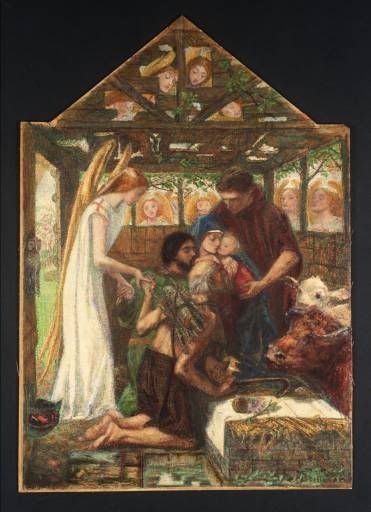
Merry Christmas to all! When I was a child this was probably my favourite Christmas Carol. Long before I saw my first Disney movie, I was fascinated by the idea of talking animals, so the idea that animals could speak on Christmas Eve was particularly attractive to me. I still remember it from a little cassette tape and book of Christmas Carols that I carried around with me for MONTHS leading up to Christmas. The tape was played so much that it always warbled during this song (and during my other favourites, the "Wassailing Song," "Good King Wenceslas" and "The Holy and the Ivy". I guess even then I had a thing for Old English Carols!
The Friendly Beasts
Jesus, our brother, kind and good,
Was humbly born in a stable rude;
And the friendly beasts around Him stood.
Jesus, our brother, kind and good.
"I," said the Donkey, shaggy and brown,
"I carried His mother up hill and down;
I carried His mother to Bethlehem town."
"I," said the Donkey, shaggy and brown.
"I," said the Cow, all white and red,
"I gave Him my manger for His bed;
I gave Him my hay to pillow His head."
"I," said the Cow, all white and red.
"I," said the Sheep, with the curly horn,
"I gave Him my wool for His blanket warm;
He wore my coat on Christmas morn."
"I," said the Sheep, with the curly horn.
"I," said the Dove, from the rafters high,
"I cooed Him to sleep that He should not cry;
We cooed Him to sleep, my mate and I."
"I," said the Dove, from the rafters high.
Thus every beast by some glad spell,
In the stable dark was glad to tell
Of the gift he gave Emmanuel,
The gift he gave Emmanuel.
Image courtesy of the Tate Gallery. It's "The Adoration" by Dante Gabriel Rossetti, and was painted between 1858 and 1864. I had actually never seen this painting before today! I just love the strong Medieval quality that it has. I'm so glad I found it!
Friday, December 12, 2008
Death, Taxes and Pre-Raphaelite Art
What do death and taxes have to do with Pre-Raphealite Art?
It seems that in today's tough economic times, Britain's millionaires are turning to their art collections when it comes time to pay the tax man. The U.K. Treasury recently accepted an art collection worth over £15 million ($22.4 million) as payment in lieu of inheritance tax. The collection of rare artworks includes paintings by J.M.W. Turner (including the watercolor Carisbrook Castle) as well as some fabulous works by members of the Pre-Raphaelite Brotherhood, including Sir Edward Burne-Jones and Dante Gabriel Rossetti. 
Among the more eccentric items in the collection is the embroidered undershirt owned by British naval hero Lord Horatio Nelson--now there's a conversation piece.
The good news is that at least a few of these objects will now be in the public domain. The Treasury has announced that several of the paintings will be returning to the five National Trust houses from which they originally come.
For more information: U.K. Receives £15M Collection in Lieu of Death Duties at ArtInfo.com
Image: JMW Turner, Carisbrook Castle, 1827(in Public domain)
Wednesday, December 3, 2008
Waltham Forest Council announces Plan to Restore Land Around the William Morris Gallery
The Waltham Forest Council has unveiled plans to help restore the land around the William Morris Gallery. The good news is that they will be working to restore historic planting areas around the gallery and working to repair the bridge from the historic gardens. The bad news is that it sounds like they will be turning the place into a bit of a concrete jungle (there are plans for massive additions to the parking area).
There will be a series of exhibitions at the William Morris Gallery on December 4, 2008 (that's tomorrow!) from 3:30-7:00 pm to discuss the proposal. Apparently that is the time to ask questions about their plans. On December 9, the exhibition will move to the Horizon Cafe in Aveling Park, Walthamstow, and it will be open until 31 May 2009. Council experts will be answering questions on Thursday 11 December and Thursday 18 December between 1pm-3.30pm, and further dates when officers will be in the cafe will be published late December.
I would be really interested to hear what some of my readers from the UK and that neighborhood think about the proposal. Please let me know if any of you attend! To see full details of the council's plans, check out their newsletter (in pdf).
You can also read more about it on the Waltham Forest website.
Thursday, November 27, 2008
Priceless Pre-Raphaelite Painting Found in Dusty Attic
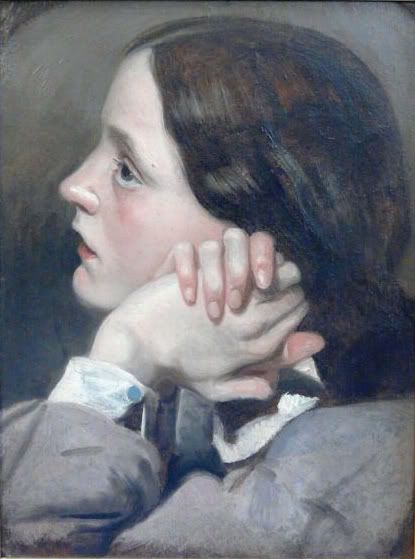
A woman in Somerset, England, recently discovered this rare portrait by John Everett Millais of his wife, Effie Millais, while she was in the process of cleaning her house.
How come stuff like this never happens to me?
Apparently, she had received the painting as a birthday gift when she was just nine years old (now that was one spoiled child!), and then forgot about it. The man who was evaluating the rest of her belongings, Duncan Chilcott, described his discovery:
"Up in the attic she wanted me to look at a table. On the other side of the room behind some old mattresses I saw the painting leaning against the wall," the Telegraph quoted him as saying.
"It was covered in thick dust and I was astonished when I blew it off and saw what was beneath."
"The lady selling it said it was purchased for her by her mother as a ninth birthday present."
Mr. Chilcott's wife later added that when the woman was informed of the painting's value, she was rather nonplussed:
"she wasn't leaping up and down but she was surprised by it. I guess it is cash in the attic for her."Perhaps her mother would have been better off getting her a bicycle for her birthday and keeping the fine art for herself.
While the owner might not be excited about the paintings' discovery, the art world is quite excited. You will recall that Effie Millais was actually married to the art critic John Ruskin before she met Millais. Because Effie's hand is hidden in this portrait, there is some speculation that it has something to do with John and Effie's relationship (or, as the Daily Mail more provocatively stated it, the "scandal of a love triangle"). The painting will be auctioned on December 9.
Read the whole story at the Daily Mail
Thursday, November 20, 2008
La Vie en Rose: The Middle Ages through Rose-Coloured Glasses
Nostalgia always brings with it a certain amount of selective memory. We idealise the past because we remember the best and forget the rest. But is this really such a bad thing? The 19th century medieval popularised by William Morris and the Pre-Raphaelites was based in the firm belief that the people of the Middle Ages had closer contact with organic elements and were thus more aware of their connection with nature and with each other. William Morris' novel News from Nowhere--(which I highly recommend, by the way)--presents a Utopian vision of the future that clearly is meant to be a recreation of an idealised medieval past.
The Nostalgic Middle Ages: 
Of course, medieval revival is fairly easy to criticise from a historical viewpoint. Morris, like his Pre-Raphaelite friends, had a habit of focusing on the positive, and carefully avoiding things like war, feudalism, disease and famine that were such problems throughout the Middle Ages (plus, many of their notions of the Middle Ages were completely inaccurate).
Morris believed capitalism was to blame for modernity's rift with nature, and that our goods-focused society created artificial needs that enslaved mankind in an endless cycle of consumption and debt (no doubt today's current market crisis would have reinforced this belief!). And while the Middle Ages were not perfect, that doesn't mean that we can't embrace what they seem to have done right. Or, perhaps we might finally acknowledge the fact that our imagined concept of the Middle Ages is actually far superior to the way things actually were! I actually think fantasy makes a much better template for the future than any reality, past or present. This is probably because I'm a historian, so I know just how much of a failure most societies have been!
The real Middle Ages? 
I'm curious to see whether the current economic upheaval will cause people to re-evaluate the Middle Ages and look to them for inspiration. I've noticed that some aspects of medieval culture, like the barter system, as the New York Times reports, are actually becoming much more widely adopted (it is expected that barter will account for $3 billion in trade in the US this year).
It will be interesting to see what develops!
Images courtesy Wikimedia. Top: Lamia (1905) by John William Waterhouse; Middle: A monk-cellarer tasting wine from a barrel whilst filling a jug. From Li Livres dou Santé by Aldobrandino of Siena - France, late 13th century.

