Monday, November 22, 2010
Did the Pre-Raphaelites Suffer from "Blurred Vision?"
This morning I came across a less-than-enthused review of "The Pre-Raphaelite Lens" in the Washington Post. In the article, Andy Grundberg criticized what he termed the "blurred vision" of the Pre-Raphaelites. And while Grundberg retained some admiration for the work done by Pre-Raphaelite landscape artists, he condemned the Brotherhood with broad strokes, arguing that "its members claimed to be interested in realism and truth" but were "far more taken with notions of fiction and theatricality."
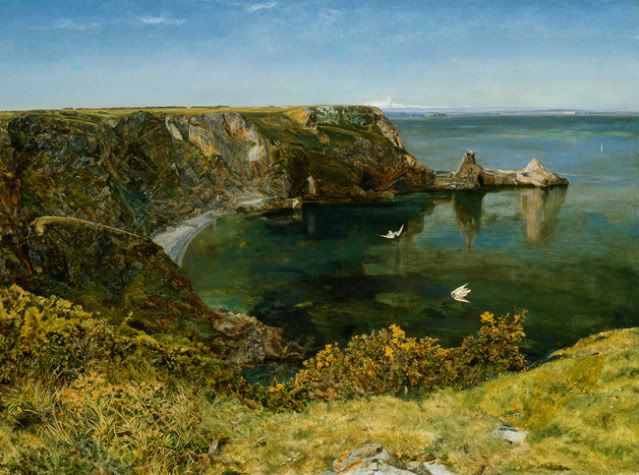
Grundberg was a photography critic for the New York Times for many years, so it's not surprising that he prefers the Pre-Raphaelites landscapes and photography to their paintings. But his criticism of the PRB is pretty standard. Many modern viewers can appreciate the work of artists like John William Inchbold (whose photograph-quality painting of Anstey's Cove is pictured here), and even Ford Maddox Brown, but remain perplexed by the romanticism of Dante Gabriel Rossetti and Sir Edward Coley Burne-Jones.
I was particularly struck by Grundberg's backhanded compliment that Julia Margaret Cameron and Henry Peach Robinson had "managed against odds to transcend their subjects' goofy origins in Arthurian legend." So now it's "goofy" to be inspired by myths and legend? Greek myth has inspired countless artists and is (quite rightly) not regarded as a "goofy" source of inspiration. Why should ancient British myths be seen differently?
Mythology is such a rich source of inspiration for artists, and it saddens me to see it dismissed off-hand. Many members of the PRB were actually very interested in a "modern" approach to art and design. They recognized that British art had become mired in convention and instead attempted to use the classics as a foundation to build from that would allow them break free from traditions that had become oppressive to artists. Even William Morris, whose passion for the middle ages is well-known, was not attempting to imitate medieval design, but to use it as a source of inspiration to create a better future.
Apparently, people today are confused that a a group that claimed to be visionary would lean so heavily on mythology and the classics for inspiration. Contemporary artists and (and their adoring critics) have the hubris to claim that they have re-invented the wheel, or are totally unencumbered by the influence of others from the past (the Young British Artists come to mind). And while this unfettered arrogance is intriguing, and can sometimes produce fascinating work, it also runs the risk of alienating the public with its hollow promise of unbridled innovation. A connection to the past and an understanding of our collective unconscious is not "goofy" - it's a fundamental part of the creative process.
Posted by
Margaret
at
4:08 PM
14
comments
Labels: Arthurian legend, edward burne-jones, medieval, mythology, pre-raphaelites, rossetti, william morris
Thursday, December 24, 2009
Happy Holidays!

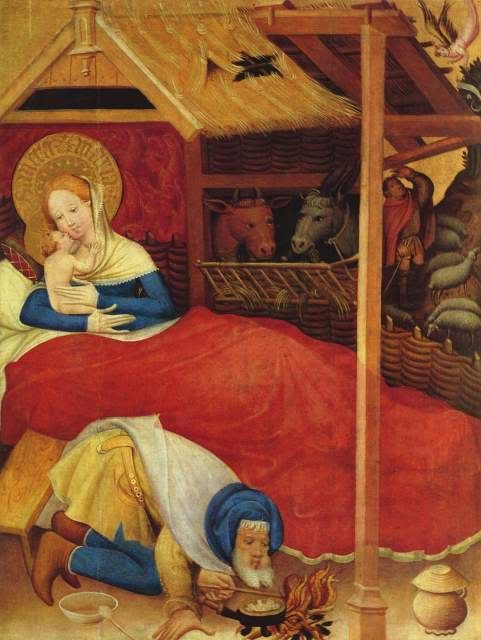
Here's a truly "Pre-Raphaelite" painting for you all! This Nativity scene was painted by Conrad von Soest in 1403. Von Soest, who was born in 1370 in Dortmund, was considered one of the greatest artists in Westphalia. He introduced the "International Courtly Style" of art to Northern Germany, and influenced Northern European art throughout the 15th century.
This image captured my eye because of its domesticity! For one thing, it was the first time I'd seen a nativity scene that featured Joseph cooking for his new family! Mary and Jesus look so tender as well (get a closer look at the expressions on their faces, and you'll know what I mean!).
Perhaps it's because this is my first Christmas with a little baby of my own, but this year I wanted to see rather more familial tenderness and a bit less distanced adoration among the Holy Family. No doubt Charles Dickens (who considered Milais' "Christ in the House of His Parents" sacrilegious for its frank portrayal of Christ's family) wouldn't have been very impressed with von Soest's more familial portrayal of the Nativity scene, but I'm sure the Pre-Raphaelites would have loved it!
On a side note, I find the ahistorical touches, such as the medieval clothing and any number of details in the painting, rather charming. Besides, I sometimes wonder if medieval artists were just trying to make historical paintings approachable for their audience. Perhaps by giving historical figures contemporary clothing and accoutrements, von Soest was ensuring that his audience would spend less time wondering why Mary and Joseph were wearing funny clothes! (what modern child didn't grow up asking their parents why Joseph ran around in a skirt and sandals all the time - I know I did!).
Happy Holidays to all, and much prosperity and happiness in the New Year!
Image courtesy of Wikipedia.
Posted by
Margaret
at
10:51 AM
3
comments
Thursday, December 25, 2008
Old English Christmas Carol

Merry Christmas to all! When I was a child this was probably my favourite Christmas Carol. Long before I saw my first Disney movie, I was fascinated by the idea of talking animals, so the idea that animals could speak on Christmas Eve was particularly attractive to me. I still remember it from a little cassette tape and book of Christmas Carols that I carried around with me for MONTHS leading up to Christmas. The tape was played so much that it always warbled during this song (and during my other favourites, the "Wassailing Song," "Good King Wenceslas" and "The Holy and the Ivy". I guess even then I had a thing for Old English Carols!
The Friendly Beasts
Jesus, our brother, kind and good,
Was humbly born in a stable rude;
And the friendly beasts around Him stood.
Jesus, our brother, kind and good.
"I," said the Donkey, shaggy and brown,
"I carried His mother up hill and down;
I carried His mother to Bethlehem town."
"I," said the Donkey, shaggy and brown.
"I," said the Cow, all white and red,
"I gave Him my manger for His bed;
I gave Him my hay to pillow His head."
"I," said the Cow, all white and red.
"I," said the Sheep, with the curly horn,
"I gave Him my wool for His blanket warm;
He wore my coat on Christmas morn."
"I," said the Sheep, with the curly horn.
"I," said the Dove, from the rafters high,
"I cooed Him to sleep that He should not cry;
We cooed Him to sleep, my mate and I."
"I," said the Dove, from the rafters high.
Thus every beast by some glad spell,
In the stable dark was glad to tell
Of the gift he gave Emmanuel,
The gift he gave Emmanuel.
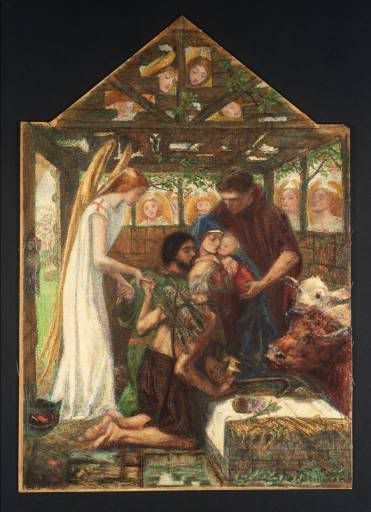
Image courtesy of the Tate Gallery. It's "The Adoration" by Dante Gabriel Rossetti, and was painted between 1858 and 1864. I had actually never seen this painting before today! I just love the strong Medieval quality that it has. I'm so glad I found it!
Posted by
Margaret
at
4:19 PM
11
comments
Labels: medieval, music, pre-raphaelites, rossetti
Thursday, November 20, 2008
La Vie en Rose: The Middle Ages through Rose-Coloured Glasses
Nostalgia always brings with it a certain amount of selective memory. We idealise the past because we remember the best and forget the rest. But is this really such a bad thing? The 19th century medieval popularised by William Morris and the Pre-Raphaelites was based in the firm belief that the people of the Middle Ages had closer contact with organic elements and were thus more aware of their connection with nature and with each other. William Morris' novel News from Nowhere--(which I highly recommend, by the way)--presents a Utopian vision of the future that clearly is meant to be a recreation of an idealised medieval past.
The Nostalgic Middle Ages: 
Of course, medieval revival is fairly easy to criticise from a historical viewpoint. Morris, like his Pre-Raphaelite friends, had a habit of focusing on the positive, and carefully avoiding things like war, feudalism, disease and famine that were such problems throughout the Middle Ages (plus, many of their notions of the Middle Ages were completely inaccurate).
Morris believed capitalism was to blame for modernity's rift with nature, and that our goods-focused society created artificial needs that enslaved mankind in an endless cycle of consumption and debt (no doubt today's current market crisis would have reinforced this belief!). And while the Middle Ages were not perfect, that doesn't mean that we can't embrace what they seem to have done right. Or, perhaps we might finally acknowledge the fact that our imagined concept of the Middle Ages is actually far superior to the way things actually were! I actually think fantasy makes a much better template for the future than any reality, past or present. This is probably because I'm a historian, so I know just how much of a failure most societies have been!
The real Middle Ages? 
I'm curious to see whether the current economic upheaval will cause people to re-evaluate the Middle Ages and look to them for inspiration. I've noticed that some aspects of medieval culture, like the barter system, as the New York Times reports, are actually becoming much more widely adopted (it is expected that barter will account for $3 billion in trade in the US this year).
It will be interesting to see what develops!
Images courtesy Wikimedia. Top: Lamia (1905) by John William Waterhouse; Middle: A monk-cellarer tasting wine from a barrel whilst filling a jug. From Li Livres dou Santé by Aldobrandino of Siena - France, late 13th century.
Posted by
Margaret
at
2:11 PM
14
comments
Labels: medieval, news, pre-raphaelites, william morris
Saturday, September 13, 2008
Tennyson and the Allure of the Medieval
Lord Alfred Tennyson composed some of the most famous lines in English poetry. Although he succeeded Wordsworth as Poet Laureate, his work has never gained the respect lavished on his predecessor, but his lonstanding popularity is unquestionable. I remember professors in University laughed at the idea of studying Tennyson. He was viewed as something of a literary joke, akin to Thomas Kinkade in the art world.
Tennyson's poetry had the ability of giving life to old narratives, particularly when it came to Arthurian literature. The Pre Raphaelites, who were drawn to this subject matter, often relied more heavily on Tennyson's interpretation of Medieval texts than they did on the original source material. This is particularly evident in "Mariana," "The Lady of Shallot," "Sir Launcelot and Queen Guinevere" and "Morte D'Arthur"--all of which were painted by Pre-Raphaelite artists.
Since I didn't post a copy of Tennyson's lovely poem, Mariana, the other day, I thought this would be an appropriate time to do so!
Mariana
WITH blackest moss the flower-plots
Were thickly crusted, one and all:
The rusted nails fell from the knots
That held the pear to the gable-wall.
The broken sheds look'd sad and strange: 5
Unlifted was the clinking latch;
Weeded and worn the ancient thatch
Upon the lonely moated grange.
She only said, 'My life is dreary,
He cometh not,' she said; 10
She said, 'I am aweary, aweary,
I would that I were dead!'
Her tears fell with the dews at even;
Her tears fell ere the dews were dried;
She could not look on the sweet heaven, 15
Either at morn or eventide.
After the flitting of the bats,
When thickest dark did trance the sky,
She drew her casement-curtain by,
And glanced athwart the glooming flats. 20
She only said, 'The night is dreary,
He cometh not,' she said;
She said, 'I am aweary, aweary,
I would that I were dead!'
Upon the middle of the night, 25
Waking she heard the night-fowl crow:
The cock sung out an hour ere light:
From the dark fen the oxen's low
Came to her: without hope of change,
In sleep she seem'd to walk forlorn, 30
Till cold winds woke the gray-eyed morn
About the lonely moated grange.
She only said, 'The day is dreary,
He cometh not,' she said;
She said, 'I am aweary, aweary, 35
I would that I were dead!'
About a stone-cast from the wall
A sluice with blacken'd waters slept,
And o'er it many, round and small,
The cluster'd marish-mosses crept. 40
Hard by a poplar shook alway,
All silver-green with gnarlèd bark:
For leagues no other tree did mark
The level waste, the rounding gray.
She only said, 'My life is dreary, 45
He cometh not,' she said;
She said, 'I am aweary, aweary,
I would that I were dead!'
And ever when the moon was low,
And the shrill winds were up and away, 50
In the white curtain, to and fro,
She saw the gusty shadow sway.
But when the moon was very low,
And wild winds bound within their cell,
The shadow of the poplar fell 55
Upon her bed, across her brow.
She only said, 'The night is dreary,
He cometh not,' she said;
She said, 'I am aweary, aweary,
I would that I were dead!' 60
All day within the dreamy house,
The doors upon their hinges creak'd;
The blue fly sung in the pane; the mouse
Behind the mouldering wainscot shriek'd,
Or from the crevice peer'd about. 65
Old faces glimmer'd thro' the doors,
Old footsteps trod the upper floors,
Old voices call'd her from without.
She only said, 'My life is dreary,
He cometh not,' she said; 70
She said, 'I am aweary, aweary,'
I would that I were dead!'
The sparrow's chirrup on the roof,
The slow clock ticking, and the sound
Which to the wooing wind aloof 75
The poplar made, did all confound
Her sense; but most she loathed the hour
When the thick-moted sunbeam lay
Athwart the chambers, and the day
Was sloping toward his western bower. 80
Then, said she, 'I am very dreary,
He will not come,' she said;
She wept, 'I am aweary, aweary,
O God, that I were dead!'
Posted by
Margaret
at
6:28 AM
9
comments
Labels: medieval, poetry, pre-raphaelites, tennyson
Friday, September 12, 2008
Mariana, by Valentine Cameron Prinsep

Valentine Cameron Prinsep's 1888 painting of Mariana borrows much from Millais' version. Both paintings feature Mariana gazing out the window of her "moated grange." Prinseps' version is decidedly cheerier, and unlike Millais' autumnal painting featuring a backdrop of dying leaves, Prinseps' is set in spring, with tulips in abundance. The painting was originally exhibited in 1888 as part of a collection of twenty-one paintings entitled "Shakespeare's Heroines."
Valentine Cameron Prinsep is a lesser-known painter of the Pre-Raphaelite school, but his connections are fairly impressive! He was born in Calcutta, India in 1838, into a rather well-known family. His aunt was the pre-eminent photographer Julia Margaret Cameron, grandmother of Virginia Woolf (do you ever get the feeling that every person you read about is somehow related?). Valentine was good friends with Millais, Rossetti, and Burne-Jones, and his artwork definitely shows his friends' influence. During his life he wrote several books and plays, but he is best remembered for his artwork.
Source consulted: Shakespeare Online (The English Department at Emory University is responsible for this great resource--I highly recommend it!).
Posted by
Margaret
at
7:53 AM
9
comments
Labels: medieval, poetry, pre-raphaelites, shakespeare, tennyson
Monday, July 21, 2008
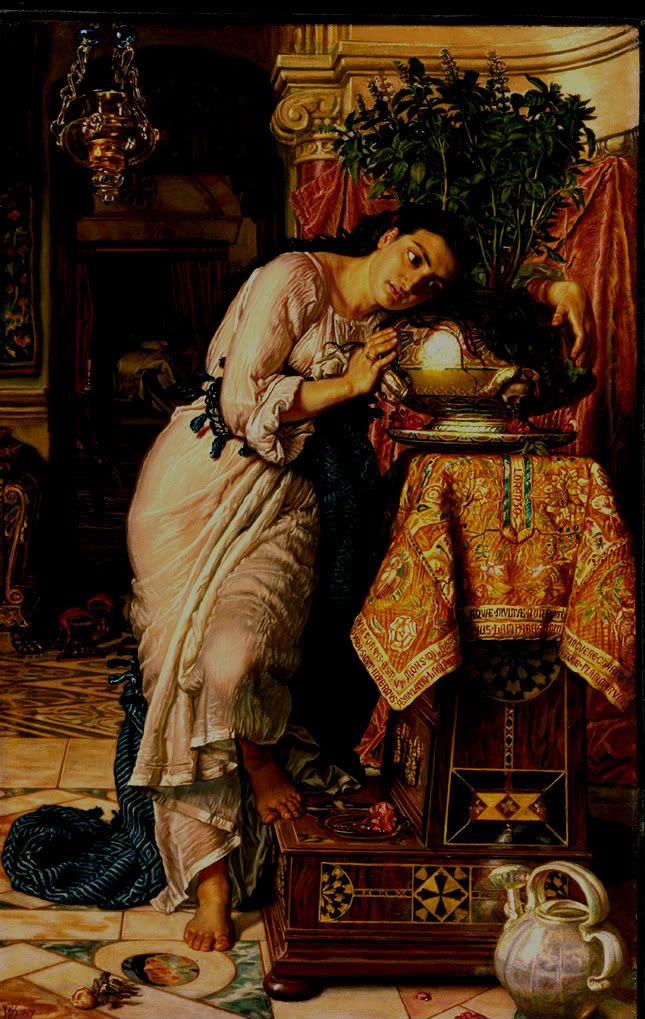
William Holman Hunt, Isabella and the Pot of Basil 1866-1868

Like Sir John Everett Millais, William Holman Hunt also chose Keat's poem "Isabella, or, the Pot of Basil" as the subject for one of his paintings. Unlike Millais, whose Lorenzo and Isabella was based on the first part of Keats' poem, Hunt chose to illustrate a scene from the second half of the poem, which was inspired by the writings of Boccaccio.
By this point in the poem, Isabella has gone to the grave yard and unearthed the head of Lorenzo from its resting place. She wraps it in a silk scarf and puts it in a garden pot, as described in the 52nd-54th stanzas of the poem:
LII.
Then in a silken scarf,—sweet with the dews
Of precious flowers pluck’d in Araby,
And divine liquids come with odorous ooze
Through the cold serpent pipe refreshfully,—
She wrapp’d it up; and for its tomb did choose
A garden-pot, wherein she laid it by,
And cover’d it with mould, and o’er it set
Sweet Basil, which her tears kept ever wet.
LIII.
And she forgot the stars, the moon, and sun,
And she forgot the blue above the trees,
And she forgot the dells where waters run,
And she forgot the chilly autumn breeze;
She had no knowledge when the day was done,
And the new morn she saw not: but in peace
Hung over her sweet Basil evermore,
And moisten’d it with tears unto the core.
LIV
And so she ever fed it with thin tears,
Whence thick, and green, and beautiful it grew,
So that it smelt more balmy than its peers
Of Basil-tufts in Florence; for it drew
Nurture besides, and life, from human fears,
From the fast mouldering head there shut from view:
So that the jewel, safely casketed,
Came forth, and in perfumed leafits spread.
Hunt used his wife Fanny, who was eight months pregnant at the time, as his model for Isabella. Their son Cyril was born a month later in October of 1866, but Fanny had a difficult time recovering her strength after the birth. She died on the 20th of December. Fanny and Hunt had only been married for 11 short months.
The painting took on a new meaning after Fanny's death. Hunt worked feverishly on the canvas, which was over 6 feet tall (73.5 x 45.5 in or 187 x 116 cm)(Hawksley, 94). I love the way that Isabella's hair mingles with the soil in the pot--it's such a beautiful depiction of her grief and her longing to be joined again with Lorenzo. Hunt would have certainly had a more emotional connection to the subject after his wife's death.
Work Consulted: The Essential Pre-Raphaelites by Lucinda Hawksley, published by Dempsey Parr.
Posted by
Margaret
at
9:21 AM
2
comments
Labels: medieval, william holman hunt
Tuesday, July 8, 2008
William Morris' La Belle Iseult

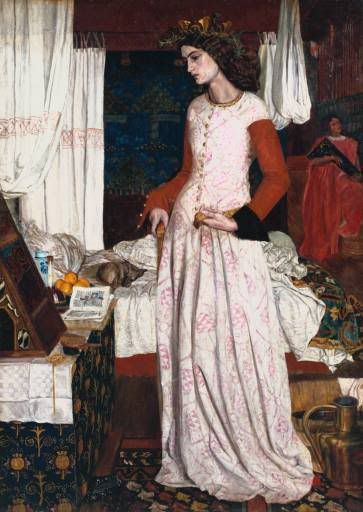
La Belle Iseult is the only painting by William Morris that exists today. The subject of the painting is Tristram's lover Iseult, and it was painted around the same time that his first book of poetry, The Defence of Guenevere , was published. It is probably for this reason that the subject of this painting is often believed to be Guinevere (both date from 1858).
William Morris composed several sketches prior to executing La Belle Iseult. In addition, the painting is believed to be partly inspired by a mural he painted in the Oxford Union in 1957.
The model for the painting is Jane Burden, who married Morris the following year. The work reveals that Morris was not as accomplished in working with oils as his friend Rossetti, as Jane appears rather pale and stiff in this rendering. Morris, who was well aware of his shortcomings as a painter, wrote with charming humility on the canvas, "I cannot paint you, but I love you."
Like many of the Pre-Raphaelite paintings, La Belle Iseult depicts a romanticised vision of the Middle Ages. And while the figures appear a bit uninspired, the textures of textiles the painting are quite striking. This work was finished long before the advent of William Morris' decorating company, but the details evident in the painting, such as the wall, bed and floor coverings--not to mention the lovely pattern on Iseult's dress--all bear witness to Morris' unparalleled talents as a draughtsman and foreshadow his involement in textile design. You will also notice that the book on the nightstand has also been carefully designed.
I adore this work. While Rossetti was much better at capturing the sensuous qualities of Jane and his other models, I think Morris' painting does an incredible job of envisioning a creative, romantic space. It gives one quite the "scope for the imagination"--don't you think?
Source Consulted: The Essential William Morris by Ian Zaczek, p. 16
Photo courtesy of the Tate Gallery
Posted by
Margaret
at
10:30 AM
5
comments
Labels: jane morris, medieval, william morris
Wednesday, June 18, 2008
Sacred and Profane Stained Glass from the Cluny
One of the things I admire most about the Middle Ages was that it was a period in which people embraced the connection between the material and the spiritual. But there was a downside to this as well. It was an extremely brutal world! This is particularly evident in the religious art of the period, which can be rather shocking to those of us reared with more Victorian conceptions of what constitutes appropriate decoration for places of worship.
They say a picture is worth a thousand words, and these examples of 13th century stained glass from the Cluny museum have got to be worth at least that. Unfortunately, a couple are a bit blurry, but I'm sure the sentiment won't be lost.
Here we have a piece of stained glass that illustrates part of the story of Samson. Rather than showing any uplifting picture of Samson tearing down the city gate, or even a picture of Delilah cutting his hair as he sleeps, the artist has chosen to show the act of his eyes being poked out. Rather dramatic! 
Here we have a rather blurry (sorry) image of John the Baptist being dispatched. Also Interesting because the artists have chosen to show John the Baptist in (then)contemporary clothing. 
Here we have a rather graphic vision of souls being awakened for the last judgement. 
Posted by
Margaret
at
5:02 AM
3
comments
Tuesday, June 3, 2008
Visit to Fougères Castle
On our first day in Rennes, Monique and Pierre drove us to a lovely Medieval village of Fougères. Fougères is located near the coast in the northwest corner of France. The village is most famous for the 11th century castle that dominates the landscape.
During the medieval period, Fougères was an important commercial centre that was known for the quality of its shoe making and weaving. In the 19th century, Victor Hugo traveled to the city to find inspiration for his novels. 
This picture, taken from the interior of the castle, shows some of the details of the chateau. I was quite surprised by the size of the stones that were used to construct the castle. Most of the other castles I've seen contain are constructed out of much pieces of stone. Our friend Pierre believed that the people who originally constructed the castle used the local stones to construct the castle because there weren't any rock quarries near by, but I haven't found any research done on this. If any one knows, please share!
Oh, and I also loved all the wildflowers growing in the crooks and crannies of the castle walls!
One of the most charming things about Fougères is that the oldest part of the town has been restored to its Medieval splendor. Many of the buildings now house touristy businesses like traditional creperies, where you sit on the patio and enjoy some cider while taking in a view of the castle!
Posted by
Margaret
at
5:02 AM
4
comments
Friday, May 30, 2008
The Medieval Mindset
I read a great opinion piece by David Brooks on the Medieval Mind in the New York Times about a month ago that I've been meaning to share. In it, Brooks bemoans the disenchantment that is the hallmark of the modern world. And while modern society has benefited from growing knowledge about the world that surrounds us, we have lost the sense of wonder and magic that seems so pervasive to the medieval worldview.
Brooks notes that, for the premoderns, the night sky was an "intimate and magical place." The heavens, to them, were a ceiling of moving spheres, rippling with signs and symbols, and moved by the love of God." C.S. Lewis once noted that the medieval world “was tingling with anthropomorphic life, dancing, ceremonial, a festival not a machine.” For us moderns, it is an expanse of "black, cold, mostly empty vastness, with planets and stars propelled by gravitational and other forces."
Brooks closes his article by reflecting on writers like C. S. Lewis and John Ruskin who "seized on medieval culture as an antidote to industrialism — to mass manufacturing, secularization and urbanization."
I sometimes wonder if knowledge must lead to disenchantment. I remember when I was a kid and I looked at the stars in the night sky in blissful ignorance. They looked so beautiful and ethereal in the night sky. I loved gazing at them. I even believed they would grant wishes (thank you Disney Pinocchio). Then a loving adult--I think it was my mom--informed me that the stars were actually just balls of gas. This was, um, not quite so romantic. It was like something snapped in my head. I continued to wonder at the beauty of nature, but it was a little depressing and disenchanting.
People often say that familiarity breeds contempt. I don't believe this is necessarily true--some things (and people!) you love even more as you get to know them better. But I also think that one of the reasons I love, say, my husband, even more as I spend more time with him, is because I believe he is more (pardon the expression) than just the some of his parts. I think that is one of the most important lessons that we can bring away from our medieval predecessors: there is more to this world than meets the eye.
Posted by
Margaret
at
5:56 AM
10
comments
Labels: c.s. lewis, medieval
Wednesday, May 28, 2008
Medieval-Inspired Umbrella Stand from Musee D'Orsay
More from the Musee D'Orsay! (Can you tell I liked this place?).
This umbrella stand was in the same room as the pictures from yesterday's post. When I looked at the picture again today, I realized that the wrought iron designs on the bottom of this early 20th century stand were copied almost directly from iron works on display at the cluny museum from the 15th century. Do you see the resemblance?

Pretty neat, eh? One of my favourite things about art is how symbols and designs are picked up and re-used over time. It just shows that if you create something of lasting value, people will continue to be inspired by it for years to come (now, where can I find an umbrella stand like that?).
Posted by
Margaret
at
5:24 AM
3
comments
Labels: decorating, france, medieval, museums
Monday, May 12, 2008
The Cluny Museum

Greetings from Paris! I am having such a good time. The last few days have gone by so quickly. Paris is just lovely right now. The weather here is amazing, though quite a bit warmer than I had expected. This is a picture of me (after hours of flying and not a wink of sleep) just after arriving at the Hotel College du France. In the picture I'm having a cafe au lait and croissant which explains my mouth being full of food!
This is a picture from the Cluny Museum. I was very interested in the sculptures and tiles they had in their collection--some of the designs were so similar to ones that William Morris revived during the Arts and Crafts Movement ( actually found one 16th century acanthus carving that looked EXACTLY like the pattern Morris always used, but the light was too low to take a proper picture. I swear he must have traced it). We went to the Cluny right after breakfast on the 10th (Saturday). As fate would have it, it turned out that Saturday was free admission day--yay!--and it's a good thing, too. Prices in Paris have absolutely gone through the roof. The first time I came here I thought Paris was a bargain--well, no longer! (we had breakfast at a rather modest cafe the next day and I noticed that a coca cola was 8 euros--twelve dollars!)
The Cluny was spectacular. A must for anyone who loves the Middle Ages--especially if they are into tapestries! They have the entire Lady and the Unicorn series there, and it is absolutely amazing to see up close, though unfortunately it's pretty much impossible to take photos, since there's no flash allowed and the room they are in keeps them in low light to preserve the colour. It really is a good thing in the long run, though, because it will preserve these fantastic works of art for another generation. One thing I was really impressed with when I saw them up close was how good the shading is. The figures seem so lively and there is so much humor injected into all of the tapestries. Definitely not the dreary mood you might imagine. My favourite from the series was "Gout" (taste). I will post a picture of it when I find a good one--such a great tapestry! Because of the light, I didn't get any tapestry picture that turned out very well, but this is for Kate! It doesn't nearly do justice to the amazing colours and textures, but c'est la vie!
Posted by
Margaret
at
9:03 AM
8
comments
Thursday, April 24, 2008
Gothic Revival and Spirituality: John Henry Newman and AWN Pugin

Thank you for all of your comments on my France trip! I'll definitely be following your advice!
Before I move on to John Ruskin's interpretation of Gothic architecture, I'd like to spend a bit more time talking about the Medieval/Gothic revival of the early 19th century that Augustus Welby Pugin was such an important part of.
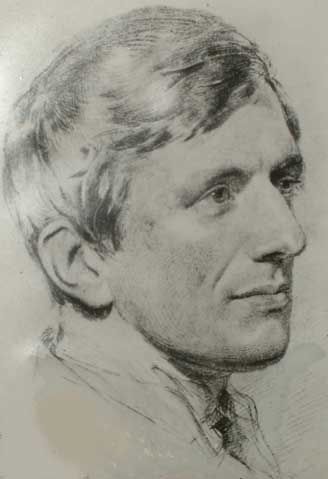
If you're a church history buff, you've probably heard of John Henry Newman (pictured right), the Anglican cleric who converted to Roman Catholicism after falling in love with the church's apostolic heritage (he later became a cardinal). Before his conversion, Newman was an extremely influential member of the Oxford Movement that aspired to return the Church of England to its Roman Catholic roots. Newman and Pugin were both heavily involved in a religious movement that idealized the Middle Ages for the spiritual awareness they believed the people of the time possessed.
During Pugin and Newman's time, Gothic Revival was closely connected to spiritual renewal, and a number of sermons were preached on the subject. Some portrayed Gothic architecture in a positive light, some did not. For example, a rather inflammatory address on Gothic Architecture entitled "The "Restoration of Churches" is the Restoration of Popery!" was given by Reverend Francis Close of Cheltenham in 1844(186).
When Newman decided to have the Chapel of St. Mary and St. Nicholas constructed in the Gothic style in 1835, it created a bit of a stir. This was prior to his conversion to Catholicism, but Newman was still a controversial figure. And while Newman did not join the Camden society--Pugin's circle of Gothic architects--he praised the style, and started his own group, the Oxford Society for Promoting the Study of Gothic Architecture (190).
Although Newman and Pugin were initially close friends, they ultimately had a falling out over (what else) the importance of Gothic architecture. Newman eventually came to beleive that, while Gothic architecture represented the perfect style for the Middle Ages, and that it should be preserved, it was not necessarily the best design for the 19th century (206). In the end, he rejected the notion that only one style could truly glorify God. This infuriated Pugin, who felt betrayed by Newman.
The lasting contribution of the early 19th century Gothic revivalists was their belief that one's moral and spiritual convictions are reflected (and informed!) by the work one produces. Augustus Welby Pugin wrote in defense of Gothic architecture that "the belief and manners of all people are embodied in the edifices they raised"(186). We will see that this sentiment had a powerful influence on the works of both William Morris and John Ruskin, although they would later re-interpret it in a more secular light. Morris himself saw Pugin's revival in Marxist terms: "the Gothic Revival was and is really connected with the general progress of the world, with...aspirations towards freedom"(206). In contrast, Pugin's desire was for the restoration of the Middle Ages, and through it "the star-gilt world that lived in his imagination"(206).
Source consulted: James Patrick, "Newman, Pugin and Gothic" Victorian Studies, Vol. 24, No. 2 (Winter, 1981): 185-207
Image courtesy wikimedia commons.
Posted by
Margaret
at
9:40 AM
2
comments
Labels: architecture, medieval, philosophy
Monday, April 21, 2008
Gothic Revival in Architecture and Augustus Welby Pugin

The Gothic Revival in architecture was one of the cornerstones of the Pre-Raphaelite and Arts and Crafts movements. And while many people familiar with the Arts and Crafts movement associate Gothic Revival with Ruskin and Morris, Augustus Welby Pugin was actually England's leading exponent of Gothic Revival in the 19th century. It was Pugin's unique, moral and artistic interpretation of the medieval period that had the greatest influence on the Arts and Crafts Movement.
The other day we examined Horace Walpole's mini Gothic revival in the 18th century. Walpole did a great deal to re-popularize Medieval style, but he knew little about architecture and his "Gothick" mansion at Strawberry Hill was about as authentic as Cinderella's castle at Disney World. So while Walpole is considered by some to be the father of Gothic revival, it's a comparison somewhat akin to calling Marie Antoinette the mother of rural revival because she constructed a play village at Versailles.
It was not until the 19th century that a more heartfelt champion of Gothic style was born. Augustus Welby Pugin was born in 1812 in London in a family of exiled Gallic Aristocrats who had fled the French Revolution. The elder Pugin worked as a draftsman for the architect John Nash. His son exhibited a natural talent at drawing and his sketches were so popular that he was chosen to design furniture for Windsor Castle at the tender age of 19! Shortly thereafter, he went into business for himself.
Pugin was the polar opposite of Horace Walpole, whose interest in Gothic style was more for entertainment value. Pugin represented the new wave of Gothic revival in the 19th century, because he saw Medieval design elements as a moral force.
Pugin converted to Roman Catholicism in his adulthood, and his conversion experience motivated him to express his faith through architecture. Unlike Walpole, who toyed about with Gothic style as a plaything, Pugin idealized the Middle Ages for its intertwining of faith and beauty. In 1836, Pugin synthesised his thoughts about the moral superiority of the Middle Ages in a book entitled Contrasts, A Parallel between the Noble Edifices of the 14th and 15th centuries and Similar buildings of the Present Day. Showing a Decay of Taste . 
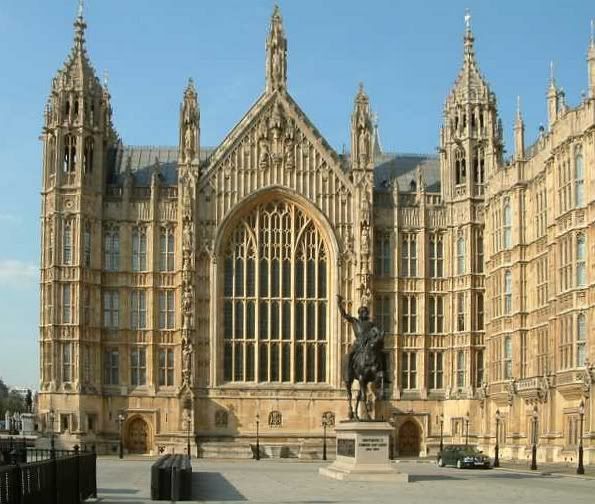
Pugin's writings struck a chord with his 19th century audience and he soon received a number of commissions. Pugin is best known for designing the interiors of the Palace of Westminster (Parliament, shown right) in London. His greatest contribution, though, was the way he recast the medieval as a moral force, something that inspired John Ruskin, and later William Morris.
Sadly, Pugin had a nervous breakdown while trying to prepare the Medieval exhibit for the Crystal Palace exhibition of 1851. He was institutionalized briefly, but was released to die at home in 1852.
For more information, see the Pugin Society. Sadly, I took a look at Project Gutenberg, and it doesn't look like any of his works are available online yet! This is a project for somebody! I would really love to read his books, and I'll definitely be posting a review once I do.
Posted by
Margaret
at
9:06 AM
4
comments
Labels: architecture, medieval, philosophy, william morris
Friday, April 18, 2008
Horace Walpole, Strawberry Hill and Gothic Revival

The appeal of Gothic architecture was so strong that it couldn't stay buried for long. The first major Gothic revival began in 1740's in England. Horace Walpole, the eccentric 4th Earl of Orford, was one of the first to re popularize the style. Walpole is one of those fascinating characters who makes the study of history worthwhile. I do so enjoy a good yarn, and Horace Walpole's life and work make for as good a story as I have ever read. Walpole was the son of Prime Minister Robert Walpole and the cousin of the famed Lord Nelson. Horace was an incurable romantic, given to dramatic and aesthetic indulgence--a bit of an 18th century Oscar Wilde (except with better breeding). Horace was quite taken with the Medieval period from an early age and decided to construct his own castle in homage to Gothic architecture. His most famous contributions to history were his neo-Gothic castle, Strawberry Field, the world's first Gothic novel, The Castle of Otranto, and the drama-laden Goth catch-phrase: "This world is a comedy to those that think, a tragedy to those that feel."
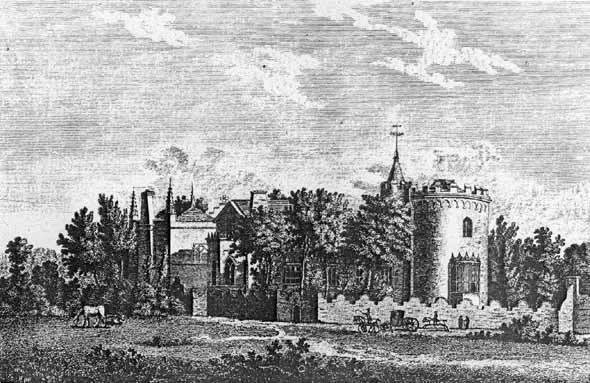
In 1747, Horace Walpole purchased a small villa near Twickenham. Together with a couple of friends, with whom he formed a "committee of taste," Walpole began working to transform the building into an estate, complete with an in-house printing press so that he could print his literary works! The resulting structure was christened Strawberry Hill. While Strawberry Hill is not an example of authentic Gothic architecture by any means, it helped inspire a movement to revive Gothic style.
Horace Walpole continued working on the house for the next 50 years. During that same time period he also wrote what is widely regarded as the first Gothic Novel, The Castle of Otranto, in 1764. He initially claimed that the novel had been discovered in the library of "an ancient Catholic family in the north of England." He also claimed that the original story dated back to the crusades. People didn't seem entirely convinced, so he eventually confessed that he had written it himself. His novel, in addition to his letters, are available here, courtesy of our friends at Project Gutenberg.
As we will see later, Horace Walpole's Gothic revival differed sharply from the revivals of the 19th century. Men like Pugin, Morris and Ruskin, admired Gothic style for its emphasis on natural beauty, whereas Walpole's revival is characterised by its extravagance and dedication to romance over nature. All of this raises an important question in my mind: both Morris and Walpole constructed anachronistic Gothic paradises for themselves (Morris at Red House and Walpole at Strawberry Hill). So was there any real difference between them? Leave a comment!
For more information on Strawberry Hill, visit Friends of Strawberry Hill, a site devoted to the preservation of Horace Walpole's project. They have some fabulous photos!
Further reading: I have gleaned some of the information in this post from a great article in Architectural History Vol. 38 (1995)entitled "Strawberry Hill: Building and Site" by Peter Guillery and Michael Snodin.
The 19th century woodcut of Strawberry Hill is courtesy of Wikimedia commons.
Posted by
Margaret
at
9:52 AM
4
comments
Labels: architecture, medieval
Thursday, April 17, 2008
Gothic Architecture
Gothic architecture and style was a major influence on the Pre-Raphaelites and the Arts and Crafts movement. For the next few days, I will be examining the history of Gothic architecture and style.
If the word "goth" conjures up images of depressed mall goth teenagers wearing too much eyeliner, it's time to re-educate yourself!
The Goths were a group of five eastern Germanic tribes after the demise of the Roman Empire. They were not architects, and have no relationship to Gothic style aside from the name.
Gothic architecture itself emerged in 12th century France and was originally called "French Style." It was the dominant style between the 12th and 16th centuries, but was later mocked by some as being "Gothic"(as in backward and barbarian). The Gothic style is characterized by mathmatic precision, symmetry and a desire to reflect the glory of God through awe-inspiring architecture.
Some of the most distinctive features of the Gothic style of architecture were the flying buttresses, used to support the height of the buildings, and pointed arches (which actually originated in Assyrian and Islamic architecture). 
You can see examples of most of these features in the photo on the right. This was taken by yours truly in Summer of 2005. I miss Paris so much! Notre Dame is a great example of Gothic architecture. You can see numerous pointed arches in the photo, along with the flying buttresses that are supporting the weight and height of the building. The buttresses were essential to creating the lithe structure of the buildings, which look like fairy palaces in comparison to the heavier structure of Romanesque architecture. 
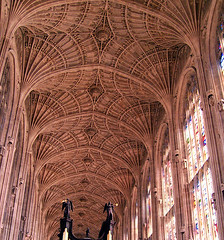
Moreover, as a result of the ribbed and vaulted ceilings they made use of, Gothic buildings were also significantly lighter and brighter inside than Romanesque structures (which is why it's kind of funny that we tend to associate anything "Gothic" with darkness). Gothic architecture was actually about creating light, bright places! This vaulted ceiling in King's College Chapel at Cambridge University illustrates the the power of the ribbed, vaulted ceiling. You can also tell from the windows on the right how this structure permitted architects to leave more room for windows. Kings College Chapel has one of the most famous and ornate vaulted ceilings in the world. I saw it in high school on a trip to England and I was absolutely dumbfounded. The sheer majesty of the architecture was breathtaking. The building was completed in 1515 under the reign of King Henry VIII.
A more detailed picture of the construction of flying buttresses can be seen below (thank you wikipedia commons!). As a side note, doesn't the very phrase "flying buttresses" sound terribly romantic? I seem to recall Anne of Green Gables saying something about them, but I can't quite remember it at the moment.
Sadly, in the wake of the Renaissance, the style police decided that Gothic architecture was abandoned. The powers that be wanted to return to a more classical style and they did for a while, but as we will see tomorrow, the enduring popularity of Gothic style led to its revival just a century later.
All images courtesy of Wikipedia Commons, save the photo of Notre Dame, which is mine!
For more information on Gothic Architecture, take a look at Yale University Press' fantastic new art history glossy, Gothic Architecture.
Posted by
Margaret
at
9:22 AM
2
comments
Labels: architecture, medieval
Friday, March 28, 2008
St Bride by Duncan

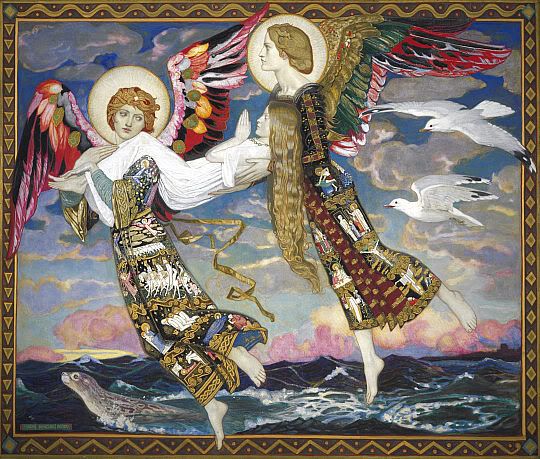
John Duncan painted St. Bride in 1913. As with most of his works, it deals with Celtic themes. The painting depicts St. Bride or St. Brigit, patron saint of smithcraft, poetry, and healing. In ancient times, Brigit was the Celtic goddess of fire. When Christian missionaries arrived, they had a hard time persuading the people to stop worshipping Brigit, so they gave up and turned her into a saint. Duncan's painting highlights the continuity between the pre-Christian and Christian periods, using celtic motits in the landscape and in his subjects' clothing, while maintaining a contemplative mood in the painting.
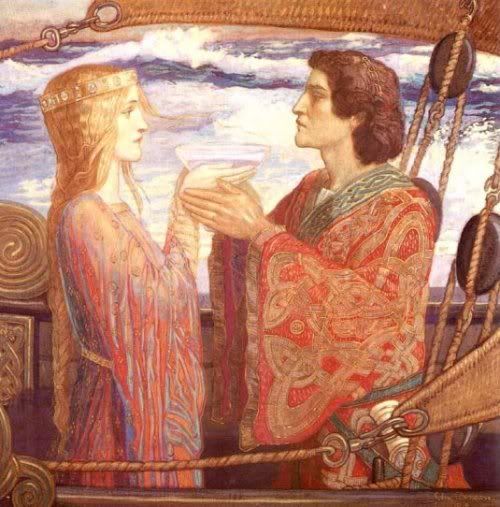
Also, like many of his works (including Tristan and Isolde), St. Bride was composed of tempera on canvas. During Duncan's time, using tempera was rather rare--it had been popular during classical times and the middle ages but was largely replaced by oil paint in the modern age. Tempera is actually made of egg yolks mixed with pigments. Although Tempera colours are not as deep as oil paint, they do not fade or change with age. Did you know that many of the cave paintings in Europe were painted using tempera?. Many mummies were also decorated with tempera paint. Duncan's frequent use of tempera set him apart from many of his contemporaries and demonstrated his dedication to the Pre-Raphaelite/Arts and Crafts ideals of a return to nature.
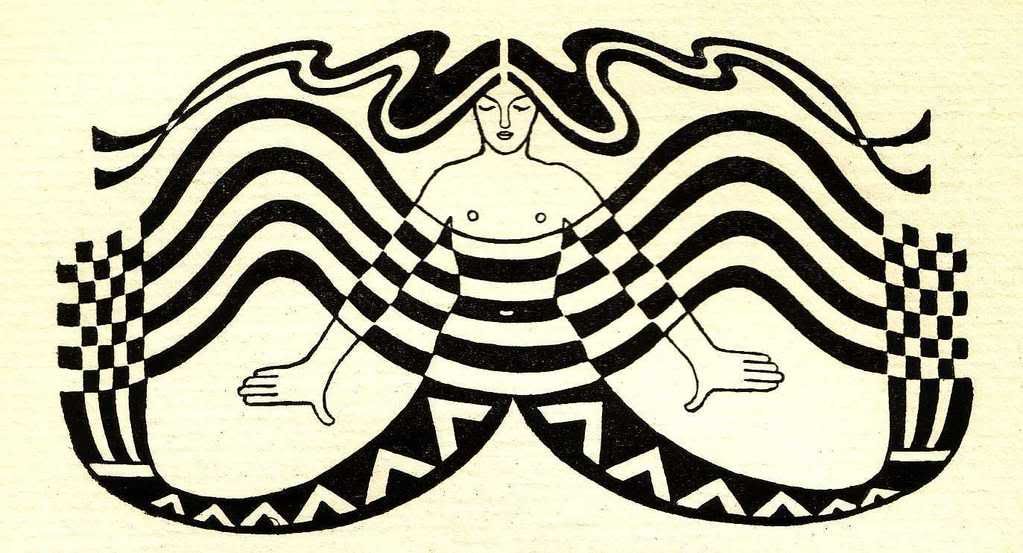
John Duncan also designed this graphic, which was used by Patrick Gedde's magazine, The Evergreeen. Does it remind you of any other corporate logo? 
Posted by
Margaret
at
10:49 AM
3
comments
Labels: medieval, pre-raphaelites
Thursday, March 27, 2008
John Duncan's Tristan and Isolde
Today I thought I'd share a bit about John Duncan. While Duncan does not have a great deal of name recognition, I'm sure most of you will recognize his painting of Tristan and Isolde, which is probably his best known work. 
Most of John Duncan's works show a strong Pre-Raphaelite influence, and he was extremely fond of painting Celtic subjects. Duncan (1866-1945) was born in Dundee, Scotland. The son of a cattle dealer, Duncan displayed talent for art very early and was enrolled at the Dundee School of Art at just eleven years of age. He spent much of his early adulthood traveling through Europe and studying the works of great artists, including Michelangelo, whose influence can be seen in his paintings.
Like many of our dear artist friends, Duncan seems to have led a rather unconventional, romantic and tragic existence. He was well known for claiming to hear "fairy music" while he painted--though what, exactly, he meant by this is not entirely known.
What we do know is that he fell desperately in love with a young girl who claimed to have fished the Holy Grail out of a well in Glastonbury. In spite of the heady romanticism of it all, their marriage ended tragically when Duncan's wife left him and took their daughters with her to South Africa.
It's a shame that Duncan seems best remembered for these two odd anecdotes. He produced a number of beautiful paintings that are still respected today (I will be posting some more tomorrow). In his own day, Duncan was well known for his writing on art, and was especially recognized for his work concerning children's art education. He also was a regular contributor to Patrick Gedde's influential magazine, The Evergreen. I would love to do more research on Duncan, but I've had some difficulty, as it appears that few books have been written about him. If anyone has come across a biography, let me know! Perhaps I'll have to be the first to write one!
Posted by
Margaret
at
10:41 AM
4
comments
Labels: fairy tales, medieval, pre-raphaelites
Monday, March 3, 2008
Decorating a la Morris

In my mind, I often associate William Morris with intricate patterns. I love his beautiful designs for textiles, wallpaper, wall and floor coverings so much that I often forget that he was a huge fan of plain surfaces. Many of our ideas of modern decorating are actually derived from the Arts and Crafts Movement, with its emphasis on clean lines and simple, useful decoration.
How to create a home with a Morris "feel"? Here are a few basic tips for Morris-inspired decorating:
1. Seek out quality furnishings that emphasise craftsmanship as opposed to stuffing your home with unnecessary clutter. For some fine examples of craftsman furniture, visit Treefrog Furniture.
2. If your home has damaged woodwork, paint it white to create a fresh "canvas." It creates a sense of lightness and brightness that was appreciated by Morris and his wife Jane, who painted the damaged paneling at Kelmscott Manor white.
3. Use local materials and designers if possible.
4. Adherence to the use of natural elements was a huge part of the Arts and Crafts Movement. Use natural materials like beautiful woods, brick and stone.
5. Nothings says neo-medieval like wrought iron! (Metal also has an incredibly earthy feel). One of my favourite re-interpretations of Medieval decorating (combined with Art Nouveau details) was the set design for Rivendell in Lord of the Rings. It was gorgeous! (you may have noticed that the Shire was heavily influenced by the Arts and Crafts Movement--take a second look at Bilbo Baggins hobbit hole! It looks like William Morris lived there!). I should do a post on Lord of the Rings set design...
6. Natural colours were another important aspect of the movement, and one that hearkened back to medieval times. Morris and others used paint schemes that were borrowed from nature, leaning heavilly on goldenrod yellows, burnished browns, cimarron and Indian reds, sage and moss greens, and a neutral palette of earthy tans, toasts, and beiges. Together, these natural colours create continuity between your home and the natural world.
7. Lighting should seem as natural as possible. Large windows are wonderful if you have them, otherwise, ligthen up your interior by choosing lighter colours and create soft (not harsh, bright) lighting with pillar lighting.
8. Decorate with books! Books are already useful, so try to make sure that they are beautiful as well. Invest in hardbacked books that you love to look at. Collect illustrated children's books. Find a bookcase you love, or better yet, build built-in bookcases!
9. Fill your home with beautiful art. This doesn't just mean paintings! Morris abhored the division in the arts between painting, sculpture, needlework and other forms of craftsmanship. Simply find beautiful things that suit your style.
10. Don't be afraid to blend! Start with one thing in the room your decorating that you LOVE. Then just gradually try to make sure that everything else in that room complements it (just another way of saying, have nothing in your houses that you do not know be useful or believe to beautiful).
Posted by
Margaret
at
8:25 AM
4
comments
Labels: decorating, medieval, william morris