Showing posts with label colombia. Show all posts

Thursday, June 10, 2010

Omar Rayo


Colombian artist Omar Rayo passed away on June 7 at the age of 82. A member of the "Op art" movement,  Rayo's work was characterized by its bold, geometric design and minimal use of color.

Rayo was born in Roldanillo, Colombia in 1928. He began working as an artist in the late 1940's as an illustrator for magazines and newspapers in Bogotá. Like many Colombian artists, he spent much of his professional life outside the country, living for many years in Mexico and New York. His museum, the Museo Rayo, was completed in his hometown of Roldanillo in 1981. The museum houses a large number of Rayo's works, in addition to a permanent collection more than 500 works by other modern and contemporary Latin American artists. Rayo was an outspoken advocate for the arts community in Colombia, and spent much of the later part of his life emphasizing the importance of supporting Colombian artists.

In the video below you can see a number of Rayo's more recent paintings, from an exhibition held last year (the artworks themselves were created in 2008).


Unfortunately, I was not very familiar with Rayo until my husband told me that he had died (although I saw some of his works when I visited the Museo Bolivariano, which is part of the Quinta de San Pedro Alejandrino in Santa Marta, Colombia). My husband had grown up admiring Rayo's work, and was sad to hear of his death.

I am constantly impressed with the artistic talent that comes out of Colombia. Colombians are hugely proud of the talented artists that have been successful on the international stage (Botero immediately comes to mind), but it is very difficult for young artists in that country. Hopefully Rayo's dreams of additional support for Colombian artists will be realized in the near future.

Omar Rayo's paintings are held in a wide variety of museums and public collections, including the Museum of Modern Art (MOMA) in New York, the Museo de Ponce in Puerto Rico, and Colombia's Museo Nacional in Bogotá.

For more information, please visit the Museo Rayo (Rayo Museum).

Image used according to fair use guidelines.

Monday, July 28, 2008

More from Quinta de San Pedro Alejandrino


The Quinta de San Pedro Alejandrino and Bolivarian Museum is a tranquil oasis in the midst of bustling Santa Marta, Colombia, and a place I would recommend to any visitor. The other day I discussed the older portion of the Quinta, but I would like to take some time to examine the newer part as well.

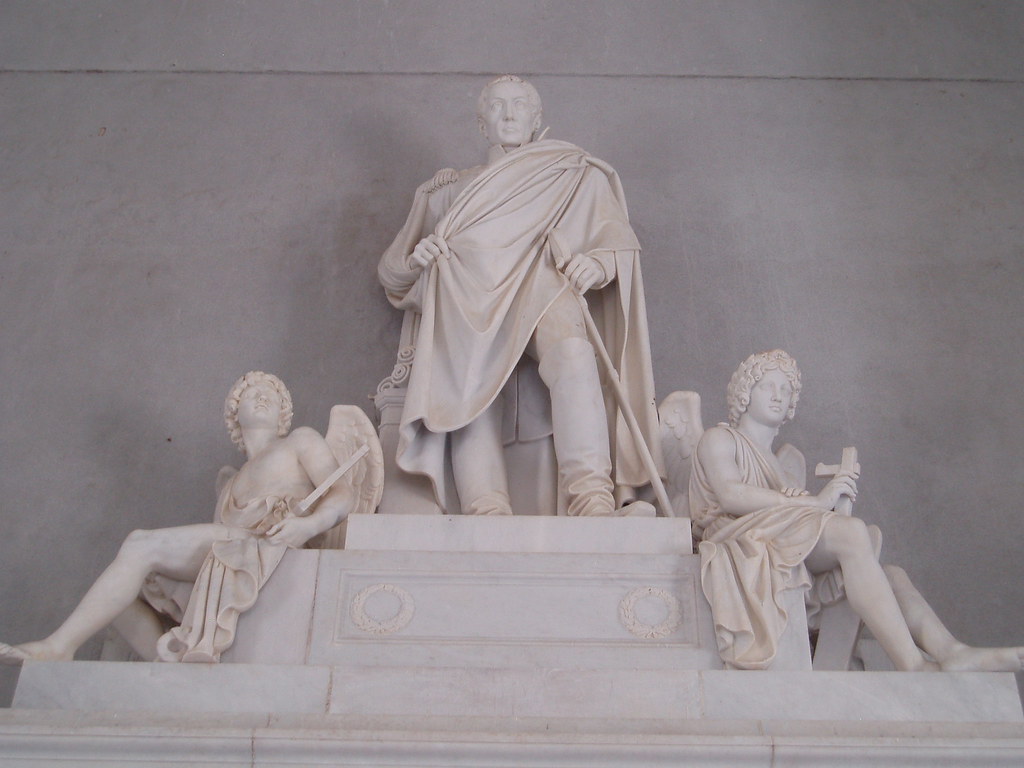
Above you can see the building that houses the "Country's Altar" located at the end of the Flags Square at the Quinta de San Pedro Alejandrino. Constructed in 1930, it is the most recent addition to the property and definitely in better shape than the original villa.

Housed within the surrounding marble structures (which were constructed even more recently) is the Bolivarian Museum of Contemporary Art, which has a fine collection of art from all around Latin America. Most of the art has a "Bolivarian" theme and is related to themes of the Spanish conquest, or liberation from colonial rule.

In case you are wondering, the ants you can see on the outside of the building were part of an art installation--not a permanent aspect of the structure! (I accidentally stumbled into a storage room filled with paper-mache ants--kind of creepy! I really don't like bugs--even giant paper bugs!).

Here we can see the top portion of the "Country's Altar," which depicts the ideals on which Colombia was built. Simón Bolívar is shown at the top. The other figures represent justice (left) and work (right).


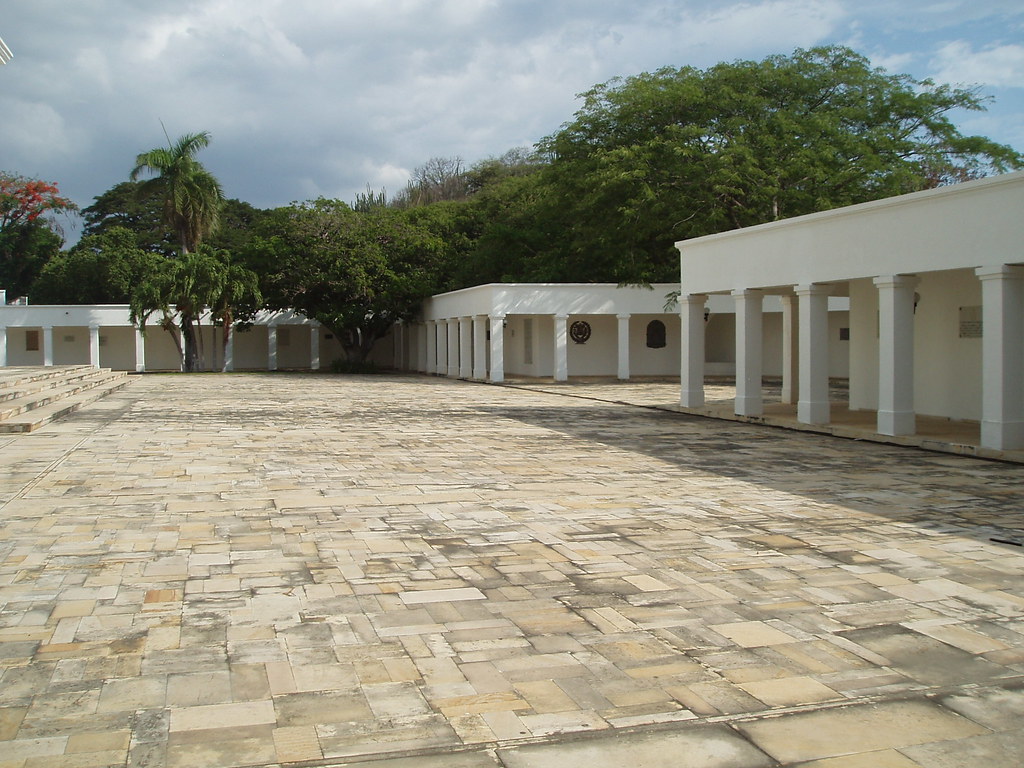
Another view of the courtyard.


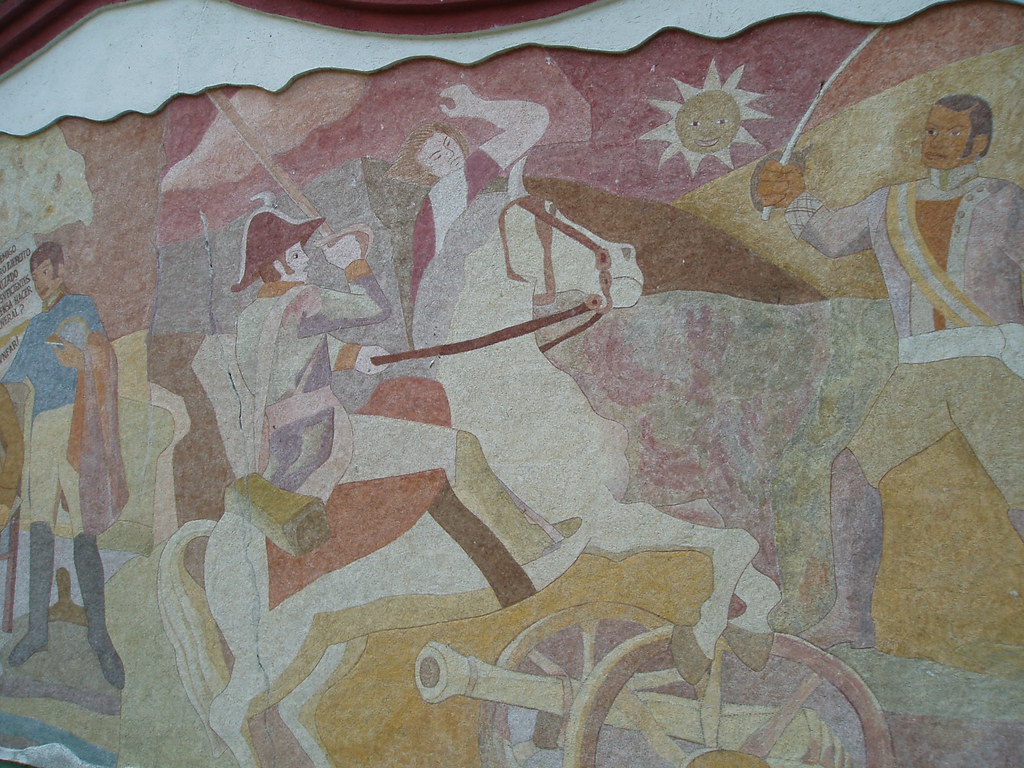
The mural below was painted in 1998 and is located on a wall just outside the courtyard. It depicts various scenes from the life of Simon Bolivar. The mural is probably almost 100 feet wide and recounts numerous episodes from Bolivar's action-packed life. Here we can see the Liberator (seated on horseback) fighting bravely against the Spanish.


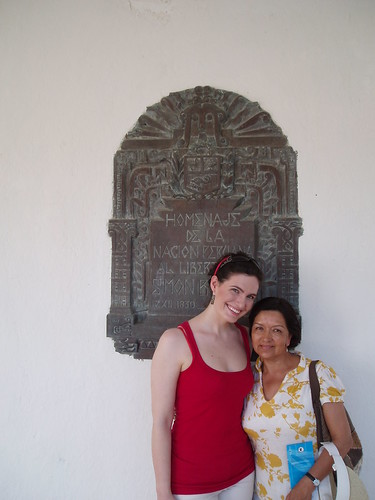
All of the countries that were liberated (or partially liberated) by Bolivar donated plaques to commemorate the construction of this monument. Here's a picture of Peru's donation (and of me with Aunt Carmen!).


I really loved seeing all the beautiful colonial architecture at the Quinta, but this newer part was beautiful as well. You could really tell that Santa Marta has invested a lot in making the Quinta de San Pedro a great tourist attraction. Our guide told us that the city of Santa Marta regularly holds benefits and other charity events in the museum and on the grounds. There is definitely a sense of "living history" here!

Thursday, July 24, 2008

Quinta de San Pedro Alejandrino in Santa Marta

One of the highlights of our trip to Colombia was seeing the Quinta de San Pedro Alejandrino in Santa Marta (a quinta is sort of a big farm in Spanish). The villa is the site where Simón Bolívar--known in Colombia as the Liberator--lived out his last days. For those of you who are not familiar with Bolívar, he holds a place in Colombian history somewhat akin to George Washington in the United States. The home is actually known as the "Sanctuary of the Motherland," and it has been well-preserved--by Colombian standards. The site is a gem that contains numerous artifacts from Bolívar's time and is definitely a must-see.


A shot of the family at the Villa. From left to right: My Father-in-Law, Fabio, Aunt Carmen, Me and Javier

The original building dates back to the 17th century. Since it was the last place Simón Bolívar lived, it has historical significance for the modern nations he liberated from Spain--Colombia, Venezuela, Ecuador and Panama. The main house is a Bolivarian museum that is worth seeing, though the preservation of many of the items is depressing (as a historian I wanted to cry when I saw such valuable original artifacts left to rot in the tropical heat and humidity).

A shot of the interior courtyard


The estate also houses a sugar mill, which has been more or less dismantled, although the outside of the structure is still lovely. One wonders why the government hasn't provided any funding for a proper restoration of the property, but then, this is Colombia we are talking about after all.


San Pedro Alejandrino Villa is open to the public from 9:00 a.m. to 5:00 p.m. Be sure to get a guide! Our guide, Manuel, was amazing--he knew all about the history of the villa and gave us lots of time to take pictures, which is always a plus. Overall I was really impressed, despite my disappointment with the museum's lack of attention to historical preservation. Oh well, you can't have everything!

Monday, July 7, 2008

Back from Colombia!


My visit to Colombia was such an amazing experience. I was so impressed by the kindness of the people we met while we were there! The fruit was probably the other thing that really wowed me--they have so many different varieties and they are all so delicious and so different!

Javier and I left Colombia on July 4th! Afterwards we spent a couple of lovely days in Miami (my first time in that city). Right now I'm staying with my mom for a few days before heading home to Canada. Washington is so beautiful right now--the weather is amazing (at least for today!).

The photo of the Colombian flag was taken by my husband at the Castillo de San Felipe in Cartagena. I'll tell you more about our visit there later this week!

Friday, June 20, 2008

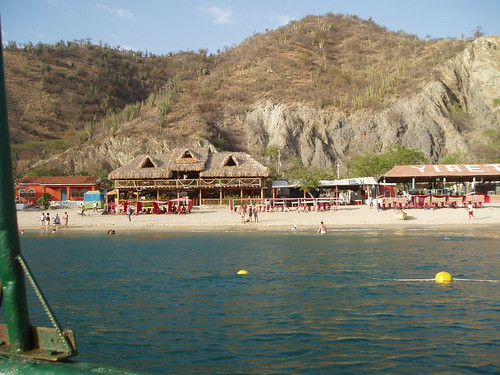
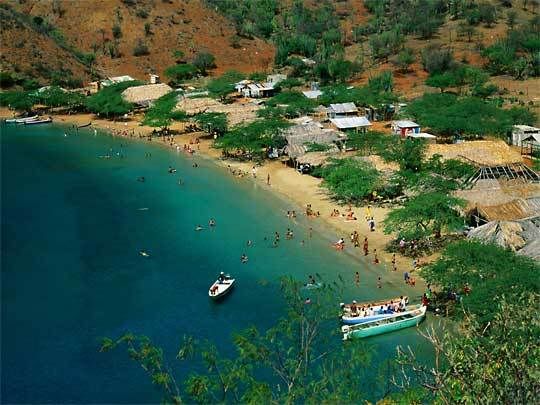
Playa Blanca, near Rodadero in Santa Marta

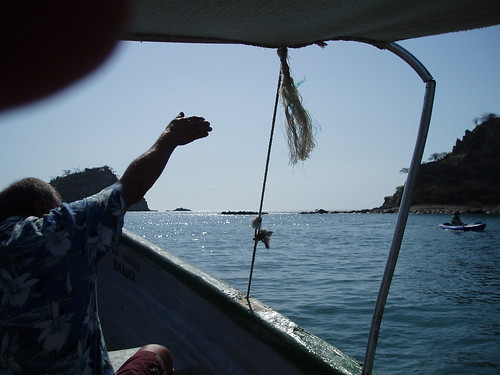
The boat trip from Rodadero to La Playa Blanca (the white beach)


Santa Marta rests on Colombia's Caribbean coast and is one of the most popular tourist destinations in Colombia, along with Cartagena.

We are actually staying in the small resort town of Rodadero, which is just a few minutes away from Santa Marta. Rodadero is well known for its beach, which is described in tourist literature as "white," which is quite a stretch of the imagination. The sand is grey and rather dirty, but it's conveniently located next to the resorts that line the beach. It's great for sunbathing and taking in the local colour (and eating a wide variety of amazing tropical treats--there are people that march up and down the beach all day selling fruit, drinks, beer (yes, you can swim and drink here in Colombia--though I would not recommend it), massages, hair braiding and the like.

If swimming is what you are into, take the time to go hire a boat to take you to Playa Blanca "white beach" for about 5 dollars (less if you are with a group). No need to reserve a boat ahead of time. If you walk anywhere on the beach in Rodadero, there are dozens of boatmen that will offer to take you to Playa Blanca, which is located on the right hand side of the bay. Or, if you prefer to walk in the sweltering heat, there is a path that will get you to the beach in a half an hour or so (in my opinion, the 5 bucks is well worth it, unless you have a bike).

One of the houses we spied on the way to Playa Blanca


Playa Blanca is much more low key than El Rodadero, although there are still plenty of services available to tourists. You can go snorkeling for hours for 8 dollars (which includes a lesson and transport to the reef). If you have goggles, take them to the beach, even if you aren't snorkeling! You'll want to take a look at some of the beautiful fish under the water.

Once you're tired swimming, there are vendors everywhere along the little beach that will be happy to sell you water, juice or a beer. In addition, there are four restaurants on the tiny beach.

Thursday, June 19, 2008

Colombia: First Impressions

I arrived in Baranquilla, Colombia last Thursday after a long flight. One of the first things that struck me was how nice the airport was! It was something I wasn't expecting. (My brother in law later told me that 80% of Colombians have never been on a plane, which helps explain why the airports have such a luxurious atmosphere, but more on that later).

After going through customs (a breeze) and border security (a bit of a pain--they rifle through all of your belongings, but I suppose it's necessary, though I'm not sure exactly what they think I might bring INTO Colombia) we emerged from the air conditioned airport and into the sweltering heat, which was a little bit overwhelming at first (it must have been close to a hundred degrees, and very humid). We met Javier's brother Fabio and his father (also Fabio) at the airport--it was so nice to finally meet them!).

From the airport we could see a bit more of the city of Baranquilla, which like the rest of Colombia, is a city full of contrasts, though the difference between rich and poor is the most striking. Immeadiately outside the airport are rows and rows of extremely meagre dwellings--roofs with the suggestion of walls. The owners sit or stand outside, attempting to sell fruit or souveniers to tourists. One thing I must say is that street vendors here are MUCH less pushy than I've seen in other parts of the world (Paris, for example). All you need to do is say "thanks" and move on. They won't bother you (as a side note though, if you're in a car, it's best to ignore them!).

The ride from Baranquilla to Santa Marta was extremely beautiful at times, and rather depressing at other times. There are a lot of invasiones--what we might call shanty towns--on the hour long drive to Santa Marta. The poverty is extreme, although I was relived to learn that there are schools for all of the kids you can see in these poor neighbourhoods. On the brighter side, we also saw lots of beautiful tropical trees and flowers from the road. The topography was so interesting, and it's amazing how much the land can change during a one hour drive (Baranquilla was humid and more lush, whereas as we approached Santa Marta the landscape became more dry and rocky).


We are actually staying in Rodadero, which is a large suburb of Santa Marta that has grown as a result of tourism. There are a large number of luxury resorts located near the beach, in addition to luxury apartments and numerous tourist-oriented shops. As you can see, our apartment is just a stone's throw from the beach (this photo was taken fromt the window).

Thursday, June 12, 2008

Voyage to Colombia

Well, I'm all done with my thesis and I'm flying to Colombia today! This will be my first time there. I've spent so much time writing and researching Colombia, but I have never been there before, so this is really exciting! I can't wait to visit the beaches and eat all that good Colombian food!

On this trip, my husband and I will be visiting the cities of Santa Marta and Cartagena.

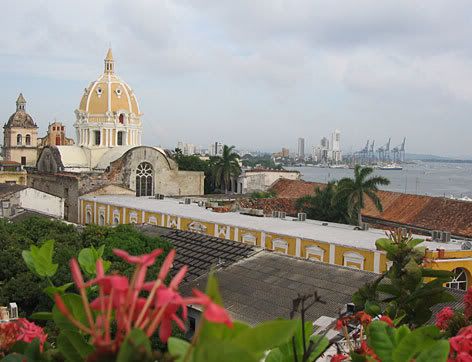
Cartagena was once the most important port in the Caribbean, and it has been regaining it's status since last year, when cruise lines started adding the city to their itinerary's. Also, if you're a history buff you might recall that the famed English privateer Sir Francis Drake ransacked Cartagena in 1586. Drake held the city for over a month and managed to collect a ransom of 110,000 ducats (for more on Drake's Caribbean exploits, see this Library of Congress article). The old part of Cartegena dates back to the early 16th century and hasn't changed all that much since Drake's time! It was named a UNESCO World Heritage site in 1984. I've been looking forward to seeing Cartagena for some time--I can't wait until I can take my own pictures!


Santa Marta is the oldest city in Colombia, and it's where we'll be spending most of our time. Santa Marta was founded in 1525 by Spanish in conquistador Rodrigo de Bastidas (unfortunately, Wikipedia doesn't provide any information about the people who lived in Santa Marta before the Spanish). Santa Marta is one the most popular tourist destinations in Colombia and has great beaches (or so I'm told).


Well, I'll do my best to keep everyone up to date while I'm traveling! I'll be sure to take lots of pictures! (I'll also be doing regular posts).