

I've collected Spode Blue Italian since I was ten years old. I have some pretty interesting pieces in my collection, like the Cheese Wedge Dish that I begged for--and received from my dear mother--for high school graduation. People might have thought it was a little odd for a ten year old to begin collecting china, but that's just the way I was! From the time I was young I recognized the beauty of the products and I still remember reading about transfer ware in Victoria Magazine and being fascinated with the time consuming, labour of love involved in creating each piece of porcelain.
So, it seemed natural to use my wedding registry as an opportunity to complete my collection. I set up my registry at Caplan Duval, here in Canada. I ended up waiting over a year due to some mysterious "reorganization" at the Spode factory. Finally, 15 months later, my first shipment of china arrived.
I was completely crestfallen when I opened the box. I hardly recognized the china. It was an odd, almond colour, with an indistinct blue-ish pattern that seemed like a caricature of the original. Moreover, the plates in the 5 piece place setting did not even stack properly with my old set because they were sized incorrectly.
Spot the knockoff: 
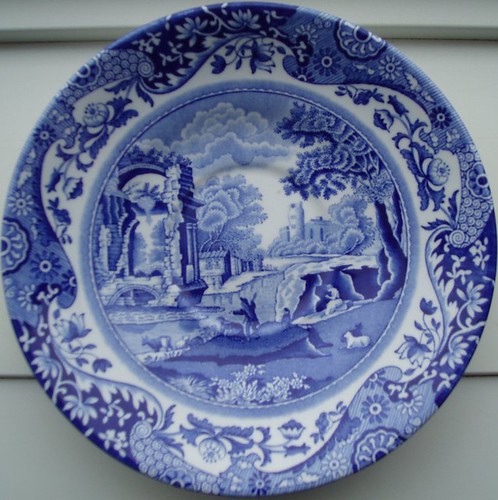

Businesses seem to apply a "one size fits all" solution to economic challenges. Outsourcing is viewed as the universal cookie-cutter response to poor sales. In their letter to my mom, the people at Spode suggested that outsourcing was their only option. For legal reasons, I cannot quote their letter on The Earthly Paradise, but their overall argument was that customers would prefer to purchase Spode products at a lower price, than spend more for Spode that had been made in England.
The next day, we discovered that Royal Worcester, the maker of Spode, was bankrupt. I wonder why!
Outsourcing is a difficult concept for me. I would personally much rather spend twice as much for a quality product made by artisans than a cheap knockoff produced by workers in a foreign factory being paid pennies an hour. I firmly believe that unhappy workers cannot create beautiful work. It doubtless comes from reading too much William Morris, but I firmly beleive in artisan work, and I don't care whether it's profitable or not! Morris and Company was always a profitable business, in that it did not lose money. But it also did not make the kind of obscene profits that most business today seem to believe they require in order to compete in the global marketplace.
I continue to hope that whichever corporation purchases Royal Worcester has better businesses ideas, but I'm not holding my breath. It seems that the world's former luxury goods producers have completely lost sight of what made their products worth having in the first place.
You can read more about Spode/Royal Worcester's financial difficulties in the Tri-City Herald.
Tuesday, November 11, 2008
The End of an Era--Spode Begins Overseas Production of Blue Italian, Then Goes Bankrupt


Server Problems
My apologies to anyone who has been having difficulties accessing my blog over the past few days. The server has been having issues, and I'm not quite sure what's wrong with it. I may be changing companies very soon if things don't improve quickly!
Thank you for your patience, and if you ever have a hard time getting The Earthly Paradise's home page to work, please try back later, and know that we aren't going anywhere any time soon!
Sunday, November 2, 2008
Edmonton Opera's Production of Wagner's The Flying Dutchman

Last week the Edmonton Opera's season began with an ambitious production of Richard Wagner's The Flying Dutchman. I wasn't quite sure what to expect from our small opera company, but I was impressed! Overall I think it was a great success, although there were some inevitable hiccups.
First of all, the music was gorgeous: my husband and I were both captivated from the moment the orchestra started playing. Once the the curtain went up, many of the cast members had a difficult time being heard above the orchestra, which I suppose is an occupational hazard of performing Wagner. Thankfully, the Dutchman (Jason Howard)and Senta(Susan Marie Pierson)had voices that were capable of standing up to the music. I personally felt that Senta stole the show. From the moment she began singing(Act 2), she really demonstrated what a more powerful voice could do with the music. The chorus numbers were another highlight, as the larger number of voices meant that the singers weren't going to be drowned out by the music.
The Flying Dutchman tells the story of a sea Captain who is condemned to wander the seas for all eternity. Once every seven years he is permitted to leave the ship in order to search for a woman who can be faithful to him until death. If he accomplishes this task, he will be freed from the curse. Unfortunately, although he has been trying for hundreds of years to find such a woman, all of them have proved unfaithful (quite a sad commentary on womankind!).
One thing that constantly impresses me about the Edmonton Opera is the great set designs that they consistently manage to pull off. This time they staged the entire production in a Shaker-style meeting hall on stilts that appeared to be tilted dramatically. I kept wondering how the cast members managed to maneuver around the stage without falling down! It really was quite extraordinary.
Ultimately, I was very happy to see an opera like this being staged in Edmonton. Doing Wagner is always difficult, but I think it was definitely worth it. Hopefully we'll get the chance to see more Wagner in Edmonton!
"The Flying Dutchman" by Albert Pinkham Ryder courtesy Wikimedia commons.
Friday, October 17, 2008
Albrecht Durer Exhibit at the Edmonton Art Gallery

Last Thursday evening my husband and I headed to the Edmonton Art Gallery to take in the last of the Albrecht Durer exhibition. I'd been meaning to go for ages, but I'd never had the time.
This was my first visit to the Art Gallery of Alberta. I have to say I was rather disappointed. The exhibit itself was rather nice--the gallery had a large selection of Durer's prints, with some fairly good notes on the exhibition. But the overall atmosphere of the museum was lacking. Perhaps this was because the AGA is undergoing renovations, and the museum is currently being held in another location (the old Hudson's Bay Building in Downtown Edmonton).
The other thing that took me by surprise was the Museum's stand on photography. While taking a picture of one of the prints with my cellphone, I was informed by one of the museum's overzealous staff members that photography was not permitted in the museum. I had not seen the sign at the museum's entrance that said we couldn't take pictures, so I innocently reassured the fellow that there was no flash. It didn't matter, he informed me, visitors could not take photographs due to copyright reasons.
Now, being a blogger, I am fairly up to date on copyright issues. There cannot be any copyright on Durer's work--it's been nearly 500 years since his death! Nevertheless, one could hold copyright on Images of Durer's work, so the museum is apparently trying to ensure that they have the only images of the work and that public will have to pay for copies of their images--which is just silly, given the fact that there are numerous copies of Durer's work in the public domain (such as the one included in this post).
I honestly have never been to a museum that did not allow non-flash photography, so I was a little taken aback. Nearly every museum in Europe allows photography, so long as there is no flash used (which makes sense, right? Museums are supposed to protect art, not keep it from the public). I do realise that keeping the public from taking flash photography can be rather challenging. I have seen priceless works of art at the Louvre being snapped with full flash, and it always makes me cringe (especially since there are signs EVERYWHERE telling people not to take flash photos). As a result, I can understand why some museums might be tempted not to permit photography at all. Nevertheless, I believe it's important to allow photography. It's important that museums be exciting, open places--The AGA is more like a tomb where art goes to die.
But back to the art. The prints were spectacular. Both of us were amazed at the depth of Durer's prints, given the fact that he was born just twenty years after the advent of the printing press! Javier's favourite was Melencolia, simply because it had so much symbolism to dissect! It was fascinating.
I have a question for you all! One aspect of Melencolia wasn't explained in the gallery's exhibition notes. That was the grid in the upper right hand corner of the painting. It reminds me a little of Sudoku. The numbers all add up to 34 in every direction, but that's all I know! If anyone knows what it is, I would love to hear from you!
(image courtesy of Wikimedia)
Saturday, October 11, 2008
The Pirates of Penzance
There is no better satire of Victorian life than the musicals of Gilbert and Sullivan. And while I enjoy all of Gilbert and Sullivan's musicals, I definitely have a soft spot for Pirates of Penzance.
I never get tired of watching the 1983 film adaptation of Pirates of Penzance, starring Kevin Kline. It tells the story of Frederick, an upstanding young man who happens to have spent his youth among pirates. On his 21st birthday, he announces that he is going to leave piracy behind and devote himself (albeit regrettably) to the "extermination" of his former friends. Once he falls in love with a girl, whose father is a Major General. Everything seems to be going well for Frederick until his former pirates friends show up and hilarity ensues.
In the end, the girls' father, General Stanley, proves himself a "model of a modern Major General" by accepting the pirates, who, after all, "with all their faults" still "love their Queen." It turns out that what they really crave is to settle down for a life of "unbounded domesticity." Of course, it doesn't hurt things when it turns out the pirates are actually peers of the realm. Being a rather dotty, social climbing member of the nouveau riche, the General immeadiately instructs the pirates to: "resume your ranks and legislative duties, and take my daughters, all of whom are beauties!"
There is no question that Kevin Kline steals the scene as the Pirate King. His sense of humor and ability is reminiscent of his peerless work in A Fish Called Wanda. His on-stage athletics are pretty impressive as well!
My sister and I watched this film more times than I could possibly count--50 at least. One of our favourite activities was attempting to sing "I am the very model of a modern Major General." Not an easy feat! The following scene includes both "Modern Major General" and the General's little song about being an orphan--which of course instantly melts the pirates' hearts (being orphans themselves, and good Englishmen at heart, they are doubtless well-schooled in the works of Dickens. It would be unthinkable to rob an orphan of his only company).
Wednesday, October 8, 2008
The Pre Raphaelites and Their World
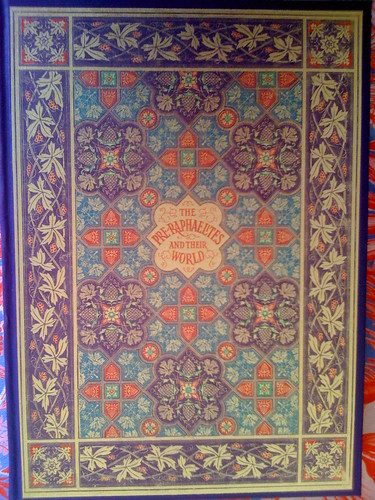
I've really been missing the University library lately. I need to get an alumni membership, but I'm afraid I haven't gotten around to that yet. But as you can see from the picture above, I am starting my own collection of Pre-Raphaelite materials!
The other day my husband and I took a stroll near our home in Edmonton to enjoy the last of the lovely fall weather. He spied this beautiful book in a shop near Whyte Avenue and made me get it! We had been scouring the used book stores near our house for books on the Pre-Raphaelites. Generally I don't see much of anything, but this book was quite a find.
The Pre-Raphaelites and Their World is William Michael Rossetti's reminiscences about his brother and the rest of the members of the Pre-Raphaelites. For those of you who are familiar with William Holman Hunt's more gossipy version of the PRB's history, William Rossetti's account is something of an adjustment. His book is far less sensational, but as a historian, I think it's a great deal more reliable! Although William acknowledges that he cannot recall minute details about conversations that had taken 50 years before (unlike Holman Hunt, who transcribed full conversations), Rossetti fills the book with fabulous anecdotes that reveal a different, more thoughtful side of the Brotherhood. I would hugely recommend it to anyone who wants to learn more about the Pre-Raphaelites.
Of course, one of the main things that stood out to me immediately about this book was its beauty. It's a 1995 Folio edition of William Michael Rossetti's writing, and the whole volume is filled with lovely photographs (most by Margaret Cameron) and Pre-Raphaelite paintings. It's a truly lovely book and it's so nice to see a relatively new book that has been so beautifully made (it even came with a lovely little case to keep it looking pretty!). I don't think it's original owner had ever even opened it--I was really lucky!
So far, my favourite aspect of the book is William Michael Rossetti's recollection of his childhood. The Rossetti household must have been such an exciting place to grow up. No wonder that Christina and Dante Gabriel were such prolific writers and artists! Their home was really the ultimate in terms of a nurturing environment (and as I mentioned in an earlier post, this was really true of Millais' home as well). How lucky the Rossetti children were! They had the chance to actually converse with all of their father's artistic and literary friends from the time they were small children. I love William's story about four year old Dante Gabriel terrifying the milkman, who "saw a baby making a picture." Perhaps he was as much a prodigy as Millais, though it's hard to know.
Although this book doesn't offer theories about the Janey-Topsy-Rossetti love triangle, I appreciate its more subdued approach. There are so many books that dwell on the scandals of the Pre-Raphaelites that it is refreshing to be reminded of the exciting ideas, talents and aspirations that this group of people had.
Wednesday, October 1, 2008
4th Art History Carnival
Welcome to the October 1, 2008 edition of art history carnival.
art history
Jason presents 1599: Beatrice Cenci and her family, for parricide posted at Executed Today, saying, "The reciprocal social construction between a family tragedy, a Romantic legend, and a (misattributed) painting."
Stephen's blog, A World Away, examines illustrated books. I really enjoyed a recent post he did on Lynd Ward's 1929 Graphic Novel, God's Man. I really enjoyed looking at the illustrations. They're quite striking and very reminiscent of the advertising art from the period.

As you may or may not have noticed, my new job is certainly keeping me on my toes! I've been neglecting my little blogging paradise quite badly (for those of you who've asked, I've been working as a Legal Assistant--an interesting job, but a very fast-paced one). Nevertheless, while I've been neglecting my own blog, there have been lots of others who've been much more faithful than I! One of these is Sheramy, from Van Gogh's Chair. Sheramy, who is a Van Gogh scholar (I guess that doesn't exactly come as a surprise, now does it? She did a much better job of naming her blog than I did! Keywords, keywords), has been busy blogging away over the last few weeks. I particularly enjoyed her recent post on Van Gogh's "Other" Starry Night, "The Starry Night Over the Rhone."
 Isn't it lovely?
Bob Aho created a lovely post that examines the Cathedral of Modena posted at Passing Gaz, it's a great article filled with photographs of the Cathedral and its fascinating relief sculptures. A must see/read!
That concludes this edition. Submit your blog article to the next edition of
art history carnival
using our carnival submission form.
Past posts and future hosts can be found on our blog carnival index page.
Technorati tags:
art history carnival, blog carnival.

